Showing posts with label The Planet is Fucked. Show all posts

Sunday, January 27, 2013

The World Fiddles While The Planet Burns: Fukushima


Update: Depleted Uranium, Diabetes, Cancer And You


A short video delivering an even shorter sharper shock. Do I think it's doom-mongering, not a bit?

A couple of short podcasts below that report on what, due to the criminal conspiracy between TEPCO and the Japanese Government, was inevitable, the massive rise in Thyroid cysts, particularly in the most vulnerable segment of the population, the young girls of Fukushima Prefecture.

And it is this collusion between TEPCO and the Japanese Government in playing down the dangers faced by that same vulnerable group, the children, that has from day one, stuck in my craw.

There is much in the sidebar under the Japan tag, but if only to exercise the point, I'm sure, criminal japanese government in the search bar will render a few results. 


With thanks to the compiler, but on a first search I could find little, other than the Youtube account of, Rosy Heart

Terribly alarming what’s happening in Japan — Signs of radiation sickness reported in children after 3/11 — Lies are being fed to the people


Dr. Helen Caldicott: It’s terribly alarming what’s happening, and the ignorance of the population, and the lies that are being fed to the people.

I’ve just been in Japan for 10 days doing a speaking tour and I had audiences of 400 people and I’d give them the medical data and statistics about radiation and then it’d turn into a medical consultation. […]

Indeed many children were reported to have had nose bleeds which means their platelets are low which is a sign of radiation sickness.

And there have been a lot of viral illnesses as well. Of course your immune system is depleted by radiation.

There’s little being done to collect the medical data. short podcast


“Continually, radioactive elements are being flushed into the Pacific” — “The Fukushima accident will never end, they have no idea how to clean it up”

Dr. Helen Caldicott: The Fukushima accident will never end. They have no idea how to clean it up because there’s never been three nuclear meltdowns in history.

Continually, radioactive elements are being flushed into the Pacific Ocean.

. . . the accident never ends because the food will continue to be radioactive as the plants suck up the radioactive elements from the soil, concentrate it, and then people will eat it — and that will go on for generations and generations. So nuclear accidents never end. short podcast

There's not much that surprises me about TEPCO, but even for them, the last sentence in this grim bit of reading, really takes the biscuit.


Tepco plans to dump ‘cleaned’ Fukushima No. 1 water

Kyodo
Jan 25, 2013

Tokyo Electric Power Co. plans to dump contaminated water from its crippled Fukushima No. 1 nuclear plant into the Pacific Ocean after removing radioactive substances to reduce contamination to legally permissible levels.

Tepco said Thursday the measure is necessary because the utility fears it will eventually run out of capacity to store radioactive water that continues to accumulate at the plant due to water being injected to help cool the three reactors that experienced core meltdowns in March 2011.

Despite the plan, the utility acknowledged it needs the approval of local governments and other parties before it actually discharges the water into the ocean. “Nothing specific has been decided at this moment,” one Tepco official said.

Water that has been used to cool the damaged reactors is recycled and used as coolant after radioactive levels in it have been lowered in a water-processing facility. But the total amount of contaminated water is increasing because the existing water flow allows an influx of about 400 tons of groundwater a day.

Tepco is increasing the number of storage tanks to deal with the situation, but warns they will eventually reach full capacity.

As a key step in the water release, Tepco will operate a new facility that can remove about different 60 types of radioactive substances, more than the existing water processing facility that has mainly worked to reduce the concentration of cesium. But as the new facility is not capable of removing radioactive tritium, an official said Tepco will consider diluting the processed water before releasing it to the sea. The Japan Times

Probably the most informative site around for all things nuclear is that of Maggie and Arnie Gundersen, Fairewinds Energy Education. http://www.fairewinds.com/video

I normally, on post like this, recommend another site, that of Alexander Higgins. Tragically however, it appears that the fellow has lost everything. Alexander Higgins House, Blog Destroyed by Sandy Flooding.

Much sympathy, I couldn't begin to imagine a disaster of such scale.

Thursday, July 19, 2012

The Planet is Fucked

And so are we. As a species we are far too successful for our own good, especially when it comes to exploiting, with total disregard, our dear Mother Earth, our home.

And when the shills for Big Energy start mumbling about the "Tipping Point" or anybody for that matter, you have my permission to fetch them a hearty slap around the lug 'ole.

The tipping point has long been and gone, all it is down to know, is where abouts we are on the 'Hockey Stick Graph.' The graph is so aptly named, for what is visually obvious, the planet has trundled along quite evenly for millions until it meets the business end of the stick, where it then takes off in an ever steepening curve.

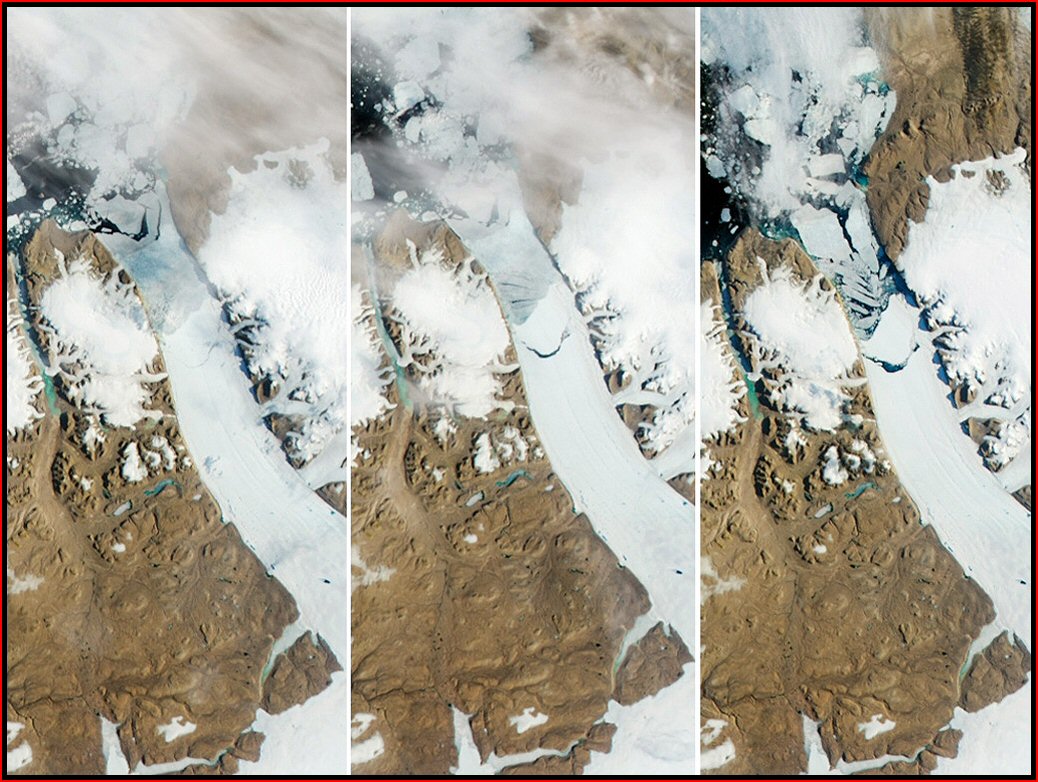
Greenland glacier calves iceberg twice the size of Manhattan
Nasa images show the ice island breaking off the Petermann glacier, for the second time in two years
19 July 2012


The Petermann glacier grinds and slides toward the sea along the northwestern coast of Greenland, terminating in a giant floating ice tongue.

An iceberg twice the size of Manhattan broke free from Greenland's massive Petermann glacier, which could speed up the march of ice into northern waters, scientists said on Wednesday.

This is the second time in less than two years that the Petermann glacier has calved a monstrous ice island. In 2010, it unleashed another massive ice chunk into the sea.

The latest break was observed by Nasa's Aqua satellite, which passes over the North Pole several times a day, and was noted by Trudy Wohlleben of the Canadian Ice Service.

"At this time of year, we're always watching the Petermann glacier," Wohlleben said, because it can spawn big icebergs that invade North Atlantic shipping lanes or imperil oil platforms in the Grand Banks off Newfoundland. A large piece of the 2010 iceberg did just that, but caused no damage, she said by telephone.

Nasa images showed the iceberg calving – breaking off from a floating river of ice called an ice tongue, part of the land-anchored Petermann Glacier – and moving downstream along a fjord on Greenland's north-west coast. A rift in the ice had been identified in 2001, but on Monday a crack was evident.

On Tuesday, the satellite images showed a bigger gap between the glacier and the iceberg, and the ice chunks further downstream were breaking up, Nasa said.

"The floating extension (of the glacier) is breaking apart," Eric Rignot of Nasa's Jet Propulsion Laboratory said in a statement. "It is not a collapse, but it is certainly a significant event."

One difference between the 2010 event and this one is that the present ice island broke off further upstream, where the ice was right up against the fjord's rocky side walls, damming the glacier's seaward movement.

"This piece that has been much further back, may have actually been providing more of a frictional force to cork (the glacier) up than the piece that broke off in 2010, which was much further out," said Andreas Muenchow, an Arctic oceanographer at the University of Delaware.

The 2010 break accelerated the Petermann glacier's movement toward the sea by 10-20%, Muenchow said. The current break could have a greater effect on the glacier's movement.

Coastal glaciers like this floating ice tongue tend to block the ice flow headed for the sea. When ice chunks break loose, the land-based glaciers behind them often move more quickly, Muenchow said.

The accelerated movement of the Petermann Glacier after the 2010 break was "noticeable but not dramatic," he said on his website.

The movement of this huge amount of ice into open water will have no immediate impact on sea levels, since this ice was already part of an ice shelf that was attached to land but extended over water, just as a melting ice cube in a glass of water does not raise the level of water in the glass.

Muenchow said climate change was a factor in the current state of the Petermann glacier. He said this glacier is as far back toward the land as it has been since the start of the industrial revolution more than 150 years ago. Gruniad


Peripheral three minutes, interesting: America's fascination with the apocalypse

Saturday, May 26, 2012

As Fukushima Goes, So Goes Japan; So Too Goes The World

It wasn't for just any old reason that a year ago now, I composed the graphic below. Befitting then, befitting now, and befitting for the foreseeable future. Unless of course, the spent fuel pool at Fukushima Daiichi Number 4 catches fire, and then I suppose, it won't matter much what kind of graphic I create.

But I think I can safely guarantee one thing, it won't be the rapture and the hand of God that takes centre stage in the final act of this little play called, The Arrogance of Man, no Sir, it will be those among us that have tried to play God.

I only mention this in passing, because I sourced the picture at the end of this post from just one of the ubiquitous sites that testify to their own puerility, the god worshippers. Of every ilk I add.


Between this post and the associated links, I suppose it's just about all there, but you will find further, including videos, under the Japan tag. The previous three posts all being relative to the spent fuel pool at Fukushima 4.

As Fukushima Goes, So Goes Japan

By The Fukushima Five

February 21, 2012

Tokyo has the largest “greater metro” population in the world at about 34.3 million. Tokyo has the largest GDP of all major cities in the world – larger than both New York City and London. Tokyo is the economic/financial capital of the world’s 3rd largest national economy, as well as the primary economic engine of East Asia.

Tokyo station is contaminated as much as the mandatory evacuation zone in Fukushima

Tokyo is contaminated as much as the worst place in Chernobyl

Fukushima, the location of the greatest nuclear power plant disaster in our age, is located a mere 238 kilometers or 148 miles from Tokyo. Unlike the Chernobyl nuclear catastrophe which occurred in a landlocked area north of Kiev Ukraine, Fukushima is located directly on the coastline of the Pacific Ocean.

Whereas Chernobyl was entombed in order to contain the environmental radiation, Fukushima is still out of control. Completely out of control, and no one yet has publicly offered a viable solution either short or long term.

Why Underground Entombment At Fukushima Daiichi Won’t Succeed

Because of the inherent dangers associated with properly diagnosing and assessing the true state of affairs at Fukushima, the on-site nuclear authorities do not even know what they don’t know!

Because of the extraordinary and ongoing level of misinformation, disinformation and false information routinely disseminated from the inception of this global environmental cataclysm, many educated onlookers believe that much of what is known with certainty has not, and will not, be shared with the public-at-large. And especially not with those unfortunate souls living within reach of proven emitted radiation whether it is carried by air, water or land.

The Japanese Government has been AWOL throughout this entire planetary ordeal. TEPCO, the responsible ‘power’ company, has been continuously out to lunch since March 11, 2011. As for the Mainstrean Media (MSM), there’s clearly nobody home. Many within the alternative media, however, have done their level best to get to the truth and publish whatever facts can be substantiated.

What’s really going on here … or rather there at FUKUSHIMA?

Why such a blackout on good info? What is so serious that a complete data lockdown was put into place from day one? Who is really calling the shots and why? Do we really want to know?! If so, then read on.

First, let us reiterate the sentiments of many deep contacts, whistleblowers and insiders within the nuclear power industry. These same strongly held convictions are also shared by many outsiders, experts who are quite competent in the related scientific and academic disciplines. We have likewise heard from the many investigative journalists and nuclear researchers who have simply applied common sense and the faculty of reason to evaluate this tragic predicament

Their collective verdict can be summed up as follows: Fukushima is, by far, the greatest technological challenge facing humanity today. Because of it’s resistance to being resolved in any meaningful way, it continues to do awesome and incalculable damage – globally – much of which is very difficult, if not impossible, to estimate or even identify.

Among the cognoscenti the following quotes represents the consensus around this whole matter:

“Does anyone in their right mind believe that nuclear power plants can ever be designed, engineered or constructed to withstand 9.0 earthquakes followed by 15 meter high tsunamis? Sorry if we offend, but such a display of so deadly a combination of ignorance and arrogance must represent the very height of hubris. Particularly in view of the inevitable consequences which have manifested at Fukushima, how is it that so few saw this pre-ordained and disastrous outcome, except by willful blindness?” ~ An Open Letter to the People of Japan

Here’s another one to boot:

“Quite purposefully, no one ever stopped to consider the obvious and far-reaching ramifications of constructing 55 nuclear reactors on the most seismically active piece of property on planet Earth! And, that doesn’t count another 12 reactors in various stages of planning or development.” ~ Japan: A Nation Consigned To Nuclear Armageddon

And then there’s this one which speaks directly to the title of this essay:

“When the actual costs are tallied, because of the proximity to the most populated metro area in the world, this disaster will be the most expensive in history. The amount required from the Japanese treasury to properly and safely remediate Fukushima are so staggering that they should have understood the true risks beforehand. However, once they sited so many nuclear reactors on the most earthquake-prone stretch of real estate in the Ring of Fire ….” ~ Japanese Nuclear Disaster: Health Watch (on Facebook)

How many truly get it yet?! Given the state of the art, which predominates throughout the entire global nuclear power industry, those nuclear reactors should never have been built anywhere in Japan. Actually, they shouldn’t have been built anywhere on Planet Earth, but that’s another story.

Moral of this story: Grossly Unsound and Extremely Dangerous Nuclear Technology is an Obvious Mismatch for a Planet Undergoing Unprecedented and Unpredictable Flux

All the seismological data indicates a dramatic uptick in earthquakes (on both land and undersea), volcanoes, and other geological phenomenon, which can profoundly affect the workings of a nuclear power plant. One hundred year, five hundred year and thousand year floods also have a way of wreaking havoc with nuclear reactors, especially when the loss of power (due to flooding) shuts down the cooling systems!

Japan Earthquakes in 2011: Visualization Map

Let’s bear in mind that Mother Nature can strike at any time throughout this earthly scenario, as she often does. Given that Japan has consistently experienced some of the highest levels of earthquake activity throughout the planet ever since such monitoring was possible, is it likely that the 9.0 was a natural event? All the seismologists seem to think so. Is there any evidence to the contrary? And if so, what cause a 50 foot tsumani that destroyed an entire coastline?

If there is credible evidence that a subsea nuclear blast caused this 15-meter wall of water, then let’s see it. Such explosions have very unique signatures and distinguishing sound features which can be easily traced and confirmed. There has been no scientific evidence that substantiates a nuclear origin of the tsunami to date.

There is also the massive amount of evidence that it currently making a trans-Pacific journey to the West Coast of America. Not sure how they plan to conceal the inevitable radioactivity associated with a deliberate nuke blast that would cling to at least some of the 25 million tons of waterborne debris. With the Twin Towers they were at least able to convey much of the most damning evidence to China by the shipload. Let’s see what shows up on Malibu before we close the book on this inquiry. Waterlogged mattresses that glow in the dark would definitely get our attention.

Japan Tsunami Debris May Soon Hit California Coast

Critical question for those who advance the theory of a nuclear blast-driven tsunami even in the absence of evidence (*Please see list of theories below):

Why would those who are at the peak of the global control matrix deliberately poison the Pacific Ocean, contaminate its sea life, and open up the myriad possibilities for a planetary contamination by radiation through sea currents and air dispersal? Who, or “What” would ever permanently poison their nest to such a self-destructive degree?!

Fukushima: A Nuclear War without a War: The Unspoken Crisis of Worldwide Nuclear Radiation

By the way we are not suggesting that nuclear weapons are not involved in this whole saga. Evidence has been introduced into the public domain which clearly indicates the likelihood that a full blown weapons program had been hiding within Japanese nuclear plants. This is a serious allegation which would probably only have come to light by an Act of God. We’re thinking about something like a mega-quake followed by a massive tsunami.

Is Japan’s Elite Hiding A Weapons Program Inside Nuclear Plants?

As for the blasts that occurred at the actual nuke plants at Fukushima, these too may be explained away by the following expose:

Secret US-Israeli Nuke Transfers Led To Fukushima Blasts

Now, back our central thesis, As Fukushima Goes, So Goes Japan. If and when this ongoing nuclear calamity starts to grow legs and decides to take a trip south – to Tokyo, for instance – we can all agree that this will be the beginning of the end. Were Tokyo to be evacuated by governmental fiat, the world’s third largest economy would immediately tank. Bear in mind that the next three largest cities in Japan are truly a stone’s throw from Tokyo (Someone really liked the view!) In order of size, the metro areas of Yokohama, Osaka and Nagoya, in the aggregate, contribute quite substantially to Japan’s GNP and, therefore, to the world economy.

Just in case you thought we were fear-mongering, the following headline appeared last September in one of the largest English newspapers in Japan:

Tokyo faced evacuation scenario: Kan

Evacuation revelations shocking

This begs the questions about why the same world controllers would conspicuously wreck the third largest economy on earth … right in the middle of the Greatest Global Depression of all time! We know they (TPTW) terribly dislike uncontrollable chaos and panic-ridden pandemonium. Would they risk a genuine global economic and financial breakdown in the midst of all the rest of their troubles?!

Not saying it’s not possible, but why in the name of Beelzebub would the Power Elite totally destroy the third largest economy on the planet, while they attempt to re-make EUROPE as the European Union disintegrates (literally) and the Euro collapses, take over an extremely unruly and unmanageable Middle East one oil-rich country at a time, and make mischief everywhere else the real Axis of Evil initiates a CIA/MI6/MOSSAD commandeered pick-your-color revolution.

Another question remains: Why would they (TPTW) forever ruin an aquatic economy known as the Pacific Ocean – the largest body of water on earth, which is also inextricably connected to all the other oceans? Don’t they eat the seafood, too? Certainly, the Pacific currents will ensure that what goes around, comes around.

There are many prophecies which speak specifically to the future of the four largest islands which comprise the nation of Japan. Might we be seeing a fulfillment of those predictions? If so, we might take consolation in the notion that whatever brought about the uniquely formidable, demanding and overwhelming challenge known as Fukushima, there is a much higher power in charge. This same “Higher Power” is behind the newly emerging and ever-evolving reality show known as 2012 on Planet Earth.

Maybe we should re-word our headline to read:

As Fukushima Goes, So Goes Japan; So, Too, Goes The World

fukushimafive


Update: From February 2012 : Gundersen: 1/3 of Fukushima kids tested positive for lumps on thyroid -- Forebodes some real issues in future -- We're only 10 months into the accident here (Audio)

Long version below, short version here.


Friday, September 30, 2011

Safety Problems in all Reactors Designed Like Fukushima


Fairewinds Introduces a Japanese Language Edition and Identifies Safety Problems in all Reactors Designed Like Fukushima


Fairewinds Introduces a Japanese Language Edition and Identifies Safety Problems in all Reactors Designed Like Fukushima from Fairewinds Associates on Vimeo.


Gundersen expresses concerns that the nuclear industry and the Nuclear Regulatory Commission are not addressing major safety issues that have become evident since Fukushima. These issues include serious design flaws in the BWR Mark 1 containment, fundamental flaws in the Boiling Water Reactor vessel design, and problems with detonation shockwaves. The NRC and the nuclear industry are using a flawed cost benefit computer code that underestimates the value of human life and minimize property damages after an accident, which has the effect of justifying continued operation of reactors without safety modifications.

Also, Fairewinds announces the launch of the Japanese language version of its site, Fairewinds.jp.

-
Transcript

Hi. I'm Arnie Gundersen from Fairewinds.

It's been about three weeks since we posted a video, although there have been a couple radio interviews posted. That doesn't mean we haven't been busy here at Fairewinds. I have been doing expert witness testimony but more importantly Maggie and Kevin Hurley have been busy converting Fairewinds.com to Fairewinds.jp which will be a Japanese translation of our website. I’d like to thank a large number of dedicated Japanese speakers who have worked with us in translating all these videos into Japanese. Today is the first day that Fairewinds.jp and Fairewinds.com will be broadcasting the same material. Thank you very much to those volunteers.

In the last several months the Nuclear Regulatory Commission (NRC) issued a review of safety as a result of the Fukushima accident. They just published their report in several key areas that they wanted to look at in more depth. That report is on our website but more importantly the Union of Concerned Scientists, acting as a watchdog over the NRC, has issued a critique of that initial nuclear regulatory report. We posted that Union of Concerned Scientists critique as well, and there are important lessons that the NRC has identified but more importantly there are issues that the Union of Concerned Scientists have recognized where the NRC needs to really put their money where their mouth is and not just study safety issues but actually implement safety changes.

Well today what I would like to talk about are four things that are not in the NRC 's report that I really think should be in the NRC's report. They are the containment, the reactor, the explosion and the last thing called Severe Accident Mitigation Analysis. The first thing is the containment on this boiling water reactor and the 35 other boiling water nuclear reactors that are exactly like that. Back in February, about three weeks before the accident, Maggie and I were walking and Maggie said, “You know we are doing a lot of expert reports and we are finding a lot of problems,” and she asked me, “Where do you think the next accident will occur?” I said I don't know where but I know for sure it will be in a Mark 1 boiling water containment. Well that's what the Fukushima reactors were: Mark 1 containments. This picture of a boiling water container was taken in the 70's. This is identical to the Fukushima reactors. Let me walk you through this.

There's two pieces to the containment, the top looks like an upside down light bulb and that's called a drywell. Inside there is where the nuclear reactor is. Down below is a doughnut looking thing called a torus and that's filled almost all the way with water. The theory is that if the reactor breaks steam will shoot out through the light bulb into the doughnut creating lots of bubbles which will reduce the pressure. This thing is called the pressure suppression containment. At the bottom of that picture is the lid to the containment. When it's fully assembled that lid sits on top.
The containment is about 1 inch thick. Inside it is the nuclear reactor that is about 8 inches thick. We will get to that in a minute. This type of containment was designed in the early 70's, late 60's, and by 1972 a lot of people had concerns with the containment. I want to read to you a NRC memo from 1972 that talks about the problems of this pressure suppression containment:

"Steve's idea to ban the pressure suppression containment scheme is an attractive one. However, the acceptance of the pressure suppression containment system by all elements of the nuclear field including regulatory and the advisory committees on reactor safeguards is firmly embedded in conventional wisdom. Reversal of this hallowed policy, especially in this time could well lead to the end of nuclear power. It would throw into question the operation of licensed plants and it would generally create more turmoil than I can stand."

So in the early 70's the NRC recognized this containment system was flawed. In the mid-70's they realized the forces were in the wrong direction: instead of down they were up, and large straps were put into place. Well then in the 80's there was another problem that developed. After the Three Mile Island [accident], they realized this containment could explode from a hydrogen build up. That had not been factored into the design in the 70's, either. What they came up for this containment was a vent in the side of it. The vent is designed to let the pressure out and a containment is designed to keep the pressure in.
So, rather than contain this radioactivity engineers realized if the containment were to survive an explosion, they'd have to open a hole in the side of it called a containment vent. These vents were added in the late 1980's and they were not added because the NRC demanded it, what the industry did to avoid that [demand] was to create an initiative. They put them in voluntarily. That sounds really in fact very proactive, but in fact it wasn't. If the NRC [had] required it, it would have opened up the license on these plants to citizens and scientists that had concerns. By having the industry voluntarily put these vents in it did two things. One, it did not allow any public participation in the process to see if they were safe and the second thing is it did not allow the NRC to look at these vents and say that they were safety related, in fact, it sidetracked the process entirely.

These vents were never tested until Fukushima. This containment was never tested until Fukushima. In fact it failed three times out of three tries. In retrospect, we shouldn’t be surprised.

Looking at the procedures for opening these vents in the event electricity fails requires someone fully clad in radiation gear to go down to an enormous valve in the bowels of plant and turn the crank two hundred (200) times to open it. Now, can you imagine: in the middle of a nuclear accident, with steam, and explosions, and radiation, expecting an employee to go into the plant and turn a valve two hundred times to open it? So, that was the second band-aid fix that failed on a containment that, forty years earlier, was designed too small.

Well, with all this in mind, I think we really need to ask the question: should the Mark 1 containment even be allowed to continue to operate? The NRC’s position is, “Well, we can make the vents stronger.” I don’t think that’s a good idea.

Now, all those issues that I just talked about are related to the Mark 1 containment. The next thing I’d like to talk about is the reactor that sits inside that containment. So, that light bulb and that doughnut are the containment structure. Inside that is where the nuclear reactor is. On a boiling water reactor, the nuclear control rods come in at the bottom. On a pressurized water reactor they come in from the top. All of the reactors at Fukushima, and 35 in the world with this design, come in from the bottom. That poses a unique problem and an important difference that the NRC is not looking at right now. If the core melts in a pressurized water reactor there are no holes in the bottom of the nuclear reactor. It’s a very thick eight to ten inch (8-10 Inch) piece of metal that the nuclear reactor core would have to melt through. But that didn’t happen at Fukushima. Fukushima was a boiling water reactor. It’s got holes in the bottom. When the nuclear core lies on the bottom of a boiling water reactor like Fukushima, or the ones in the U.S., or others in Japan, it’s easier for the core to melt through because of those sixty (60) holes in the bottom of the reactor. It doesn’t have to melt through eight inches of steel. It just has to melt through a very thin-walled pipe and scoot out the hole in the bottom of the nuclear reactor.

I’m not the only one to recognize that holes at the bottom of a boiling water reactor are a problem. Last week an email came out that was written by the Nuclear Regulatory Commission right after the Fukushima accident where they recognized that, if there’s a core meltdown and it’s now lying as a blob on the bottom of the nuclear reactor, these holes in the bottom of the reactor form channels through which the hot molted fuel can get out a lot easier and a lot quicker than a thick pressurized water reactor design. This is a flaw in any boiling water reactor, and the Nuclear Regulatory is not recognizing that the likelihood of melting through a boiling water reactor like Fukushima is a lot more significant than the likelihood of melting through a pressurized water reactor.

The third area is an area we’ve discussed in depth in a previous video. That area is that the explosion at Unit 3 was a detonation, not a deflagration. It has to do with the speed of the shockwave. The shockwave at Unit 3 traveled faster than the speed of sound, and that’s an important distinction that the Nuclear Regulatory Commission, and the entire nuclear industry is not looking at. A containment can’t withstand a shockwave that travels faster than the speed of sound, yet all containments are designed assuming that doesn’t happen. At Fukushima [Unit] 3, it happened. We need to understand how it happened and mitigate against it in the future on all reactors. Now, I measured that. A scale the size of the building against the speed at which the explosion occurred, and determined that that shockwave traveled at around a thousand miles per hour. The speed of sound is around six hundred feet per second (600 ft/sec) so, if this is what I think it is, it could cause enormous damage to a containment. They are not designed to handle it. Yet, the NRC is not looking at that.

So, we’ve got three key areas where the NRC and the nuclear industry don’t want people to look, and [those are, one]: should this Mark 1 containment even be allowed to operate? Two: are boiling water reactors more prone to a melt-through than a pressurized water reactor? And the third is: can containments withstand a detonation shockwave?

If the nuclear industry wants to implement a safety change, they have to do something called a cost-benefit analysis. What that means is the cost to implement the change has to be exceeded by the benefits to society if the change is made. This brings me to the last point today which is called “SAMA,” S, A, M, A. It stands for Severe Accident Mitigation Analysis. It uses a really fancy computer code that calculates exactly what the costs are to society in the event of a big accident. Those costs are in terms of human life, and they’re in terms of damages to property. The computer code is wrong. It’s been known to have been wrong for a long time, but it continues to be in use. The Nuclear Regulatory Commission puts the lowest possible value on a human life of any of the agencies in Washington. And, the cleanup after an accident is also artificially low. The net effect is that when a cost to make a modification is compared against the benefits to society, this computer code distorts the benefits and lowers them. So, it appears that there’s no need to make the change because the costs are too high and the benefits to you and I, and society, are too low. Fukushima has taught us that that’s just not true. The costs to clean up Fukushima are going to be in the hundreds of billions of dollars U.S. [The costs will be] at least two hundred billion dollars U.S. And yet, this computer code that the Nuclear Regulatory Commission uses never, ever, calculates a high number like that. Unless we adjust the cost/benefit analysis, what will happen is: as the Nuclear Regulatory Commission identifies problems that should be corrected, their own computer code will show that it’s not justified, that the risks to society are really too low, that we don’t need to spend that money. The problem is in the computer code, and until we upwardly adjust the cost of a human life, and the cost of damage to property we won’t be able to come up with an effective way of judging the costs and the benefits of these safety modifications.

Well, that about sums it up. There are at least three key areas that the Nuclear Regulatory Commission and the nuclear industry, both in Japan and the United States, are not looking at: containment design, boiling water reactor vessels, and detonation shockwaves. But, no matter what they look at, if they don’t do the cost/benefit analysis right and properly evaluate the cost to society, none of these changes will be implemented.

Again, I’d like to thank our Japanese viewers and welcome them to Fairewinds.jp, and also to thank all of our viewers over the last one hundred and seventy days, and thank them for watching Fairewinds.com.

Fukushima Desolation Worst Since Nagasaki as Residents Flee

Before moving on to the article I would just like to say a few words about this fellow, Jim, I've no axe to grind, Al-Khalili. He has a PhD in theoretical nuclear physics and I don't.

I had the misfortune recently, to watch him present a television program, Fukushima: Is Nuclear Power Safe? Where, from the off, he reassured us of his impartiality.

Oh how I wish, because I can honestly say, I have never watched such unmitigated biased drivel in all my fucking life. So much so, had you watched the program and taken it at face value, you would have come away with the opinion that both Chernobyl and Fukushima were a couple of inconsequential mishaps.


Just my opinion mind, but he did seem to be just the man for the ever so impartial BBC.

BBC: Six months after the explosions at the Fukushima nuclear plant and the release of radiation there, Professor Jim Al-Khalili sets out to discover whether nuclear power is safe.

He begins in Japan, where he meets some of the tens of thousands of people who have been evacuated from the exclusion zone. He travels to an abandoned village just outside the zone to witness a nuclear clean-up operation.

Jim draws on the latest scientific findings from Japan and from the previous explosion at Chernobyl to understand how dangerous the release of radiation is likely to be and what that means for our trust in nuclear power.


Fukushima Desolation Worst Since Nagasaki as Residents Flee
By Yuriy Humber, Yuji Okada and Stuart Biggs
Sep 27, 2011

Beyond the police roadblocks that mark the no-go zone around Japan’s wrecked Fukushima nuclear plant, six-foot tall weeds invade rice paddies and vines gone wild strangle road signs along empty streets.

Takako Harada, 80, returned to an evacuated area of Iitate village to retrieve her car. Beside her house is an empty cattle pen, the 100 cows slaughtered on government order after radiation from the March 11 atomic disaster saturated the area, forcing 160,000 people to move away and leaving some places uninhabitable for two decades or more.

“Older folks want to return, but the young worry about radiation,” said Harada, whose family ran the farm for 40 years. “I want to farm, but will we be able to sell anything?”

What’s emerging in Japan six months since the nuclear meltdown at the Tokyo Electric Power Co. plant is a radioactive zone bigger than that left by the 1945 atomic bombings at Hiroshima and Nagasaki. While nature reclaims the 20 kilometer (12 mile) no-go zone, Fukushima’s $3.2 billion-a-year farm industry is being devastated and tourists that hiked the prefecture’s mountains and surfed off its beaches have all but vanished.

The March earthquake and tsunami that caused the nuclear crisis and left almost 20,000 people dead or missing may cost 17 trillion yen ($223 billion), hindering recovery of the world’s third-largest economy from two decades of stagnation.

Compensation Costs

A government panel investigating Tokyo Electric’s finances estimated the cost of compensation to people affected by the nuclear disaster will exceed 4 trillion yen, Kyodo News reported today, without saying how it got the information. The stock fell 6.2 percent to 243 yen, the lowest since June 13.

The bulk of radioactive contamination cuts a 5 kilometer to 10 kilometer-wide swath of land running as far as 30 kilometers northwest of the nuclear plant, surveys of radiation hotspots by Japan’s science ministry show. The government extended evacuations beyond the 20-kilometer zone in April to cover this corridor, which includes parts of Iitate village.

No formal evacuation zone was set up in Hiroshima after an atomic bomb was dropped on the city on Aug. 6, 1945, though as the city rebuilt relatively few people lived within 1 kilometer of the blast epicenter, according to the Hiroshima Atomic Bomb Museum. Food shortages forced a partial evacuation of the city in the summer of 1946.

Chernobyl Explosion

On April 26, 1986, an explosion at the Chernobyl reactor hurled 180 metric tons of nuclear fuel into the atmosphere, creating the world’s first exclusion zone of 30 kilometers around a nuclear plant. A quarter of a century later, the zone is still classed as uninhabitable. About 300 residents have returned despite government restrictions.

The government last week said some restrictions may be lifted in outlying areas of the evacuation zone in Fukushima, which translates from Japanese as “Lucky Isle.” Residents seeking answers on which areas are safe complain of mixed messages.

“There are no simple solutions,” Timothy Mousseau, a professor of biological sciences at the University of South Carolina, said. Deciding whether life should go on in radiation tainted areas is a “question of acceptable risks and trade offs.”

To Mousseau, one thing is clear.

‘Consequences’

“There will be consequences for some of the people who are exposed to levels that are being reported from the Fukushima prefecture,” Mousseau said by e-mail from Chernobyl, where he is studying radiation effects.

Japan abandoned any ambition to develop atomic weapons after the 1945 bombings. Two decades later, the nation embraced nuclear power to rebuild the economy after the war in the absence of domestic oil and gas supplies.

Tokyo Electric’s decision in the 1960s to name its atomic plant Fukushima Dai-Ichi has today associated a prefecture of about 2 million people that’s almost half the size of Belgium with radiation contamination. In contrast, Chernobyl is the name of a small town near the namesake plant in what today is Ukraine.

The entire prefecture has been stained because of the link, according to Governor Yuhei Sato.

“At Fukushima airport you don’t see Chinese and Korean visitors like before because of negative associations,” he said. More Bloomberg

Thursday, September 29, 2011

Fukushima’s Contamination Produces Some Surprises at Sea


Fukushima’s Contamination Produces Some Surprises at Sea

By David Jolly
September 28, 2011

Six months after the accident at Fukushima Daiichi, the news flow from the stricken nuclear power plant has slowed, but scientific studies of radioactive material in the ocean are just beginning to bear fruit.


The word from the land is bad enough. As my colleague Hiroko Tabuchi reported on Saturday, Japanese officials have detected elevated radiation levels in rice near the crippled reactors. Worrying radiation levels had already been detected in beef, milk, spinach and tea leaves, leading to recalls and bans on shipments.

Off the coast, the early results indicate that very large amounts of radioactive materials were released, and may still be leaking, and that rather than being spread through the whole ocean, currents are keeping a lot of the material concentrated.

Most of that contamination came from attempts to cool the reactors and spent fuel pools, which flushed material from the plant into the ocean, and from direct leaks from the damaged facilities.

Japanese government and utility industry scientists estimated this month that 3,500 terabecquerels of cesium 137 was released directly into the sea from March 11, the date of the earthquake and tsunami, to late May. Another 10,000 terabecquerels of cesium 137 made it into the ocean after escaping from the plant as steam.
Ken Buesseler, a marine chemist, paid his respects at Namiwake Shrine outside the city of Sendai, Japan, before departing on a cruise to study radiation releases into the ocean from the Fukushima power plant.Ken Kostel, Woods Hole Oceanographic InstitutionKen Buesseler, a marine chemist, paid his respects at Namiwake Shrine outside Sendai, Japan, before departing on a cruise to study radiation releases into the ocean from the Fukushima power plant.

The leakage very likely isn’t over, either. The Tokyo Electric Power Company, the operator of the plant, said Sept. 20 that it believed that something on the order of 200 to 500 tons a day of groundwater might still be pouring into the damaged reactor and turbine buildings.

Ken Buesseler, a scientist at the Woods Hole Oceanographic Institution, who in 1986 studied the effects of the Chernobyl disaster on the Black Sea, said the Fukushima disaster appeared to be by far the largest accidental release of radioactive material into the sea.

Chernobyl-induced radiation in the Black Sea peaked in 1986 at about 1,000 becquerels per cubic meter, he said in an interview at his office in Woods Hole, Mass. By contrast, the radiation level off the coast near the Fukushima Daiichi plant peaked at more than 100,000 becquerels per cubic meter in early April.

Before Fukushima, in 2010, the Japanese coast measured about 1.5 becquerel per cubic meter, he said.

‘‘Chernobyl might have been five times bigger, over all, but the ocean impact was much smaller,’’ Mr. Buesseler said.

Working with a team of scientists from other institutions, including the University of Tokyo and Columbia University, Mr. Buesseler’s Woods Hole group in June spent 15 days in the waters off northeast Japan, studying the levels and dispersion of radioactive substances there and the effect on marine life.

The project, financed primarily by the Moore Foundation after governments declined to participate, continued to receive samples from Japanese cruises into July.

While Mr. Buesseler declined to provide details of the findings before analysis is complete and published, he said the broad results were sobering.

“When we saw the numbers — hundreds of millions of becquerels — we knew this was the largest delivery of radiation into the ocean ever seen,’’ he said. ‘‘We still don’t know how much was released.’’

Mr. Buesseler took samples of about five gallons, filtered out the naturally occurring materials and the materials from nuclear weapon explosions, and measured what was left.

The scientists had expected to find ocean radiation levels falling off sharply after a few months, as radioactive substances were dispersed by the currents, because, he said, “The ocean’s solution to pollution is dilution.’’

The good news is that researchers found the entire region 20 to 400 miles offshore had radiation levels too low to be an immediate threat to humans.

But there was also an unpleasant surprise. “Rather than leveling off toward zero, it remained elevated in late July,’’ he said, up to about 10,000 becquerel per cubic meter. ‘‘That suggests the release problem has not been solved yet.”

The working hypothesis is that contaminated sediments and groundwater near the coast are continuing to contaminate the seas, he said.

The international team also collected plankton samples and small fish for study. Mr. Buesseler said there were grounds for concern about bioaccumulation of radioactive isotopes in the food chain, particularly in seaweed and some shellfish close to the plants. A fuller understanding of the effect on fish that are commercially harvested will probably take several years of data following several feeding cycles, he said.

‘‘We also don’t know concentrations in sediments, so benthic biota may be getting higher doses and if consumed (shellfish), could be of concern,’’ he wrote later in an e-mail, referring to organisms that dwell on the sea floor.

The study also found that the highest cesium values were not necessarily from the samples collected closest to Fukushima, he said, because eddies in the ocean currents keep the material from being diluted in some spots farther offshore.

The overall results were consistent with those previously found by Japanese scientists, Mr. Buesseler said.

He said more research was urgently needed to answer several questions, including why the level of contamination offshore near the plant was so high.

“Japan is leading the studies, but more work is needed than any one country, or any one lab, can possibly carry out,” he said. NYT

h/t TreeHugger

Saturday, September 03, 2011

The Planet Is Fucked Gulf of Mexico Edition

Jeebus! wait until you see the size of this bugger.


New evidence of a massive oil slick near Deepwater Horizon site
By David Edwards
09.1.11

A California nonprofit organization dedicated to the protection and preservation of wildlife has discovered what seems to be a massive oil slick in the Gulf of Mexico near the area of the original Deepwater Horizon spill.

In a flight over the Gulf Tuesday, OnWingsOfCare.org founder and pilot Dr. Bonny Schumaker spotted an oil slick that stretched for nearly 10 miles.

Last week, two Louisiana State University men took a boat into the Gulf and returned with video evidence of large blooms of crude oil swelling up to the water’s surface where the doomed oil rig once hovered.

BP had firmly denied that the well is continuing to leak.

“None of this is true,” they said in a statement.

Watch this video from OnWingsOfCare.org, uploaded Aug. 30, 2011.

Raw Story


Wednesday, August 24, 2011

North Anna - Fuhushima - Alexander Higgins - Fairewinds Associates

I received an email, alerting to the earthquake that hit the North Anna Nuclear Power Plant in Virginia. Only because it is personally au courant, (I plan to attend a local meeting later in the week on the subject of fracking) that I wondered if indeed fracking had played a role in the event.

That doesn't appear to be the case, or none that I could find. Rather more a case of building the thing in the wrong goddamned place to start with. Let me paraphrase: Nuclear power plants are the world's most expensive fault-line detectors.

The Daily Kos has a bit on the cover up sighting of the plant:

Louis Zeller, the League’s legal representative, said that Dominion covered up evidence of a geologic fault in the 1970’s and that they now want a variance because they cannot meet safety standards.

The Daily Kos thing came up as a result doing the rounds to see how the main stream media were spinning this. But like any of us these days, unless absolutely forced, the MSM is not a pool we like to paddle in, and the case never more so, than when money and nuke power are involved.

Choosing rather, to gather our information, to visit those who we feel are telling it like it is. My first ports of call for things nuclear are, Fairewinds Associates and blogger Alexander Higgins. Fairewinds had nothing on the North Anna plant as yet, but that didn't surprise me greatly, Fairewinds aren't a ''daily scoop'' kind of a site, preferring as they do to analyse the data first before issuing their findings.

No, to keep abreast of the breaking and daily news, it is to Alexander Higgins that I go. And having said that, I am going to leave no more than this link to the North Anna story, because it is after all Arnie Gunderson's latest report on Fukushima that I want to bring to the fore. Update here. But for real scary stuff there is this video report from Helen Caldicott, who touches on many things, Chernobyl, food, Depleted Uranium, Iraq birth defects et al.

In fact the clip is so compelling I am going to embed it. But do visit web page, for there is much more to be found there, including another Arnie Gunderson clip.


Though based on nothing more than I have read, other than that is, applying that which I hold dear to me, hold more dearly than brains, for it is oft the case that just one ounce of common sense is worth a pound of the grey matter, and it is that which I apply to the situation in Fukushima, common sense. It is such an application that caused me to write this.

The potential for a collapse of a society is I think a very real threat. That great swathes of this comparatively small country are almost certain to become uninhabitable, its level of food production decimated and groundwater contaminated forever, cannot be underestimated or written off.

Add to these not insignificant woes, the future prospect of untold numbers of health related problems, the future does indeed look grim. And to be taken into consideration, the very real threats to Japan's manufacturing industries and potential loss of markets, it becomes increasingly difficult to see how Japan can perform as a functioning society.

The seemingly devil may care attitude by vast majority to what is actually happening in Japan reminds me of a story once told to me by a friend, John.

John and a colleague had occasion to conduct some business north of the border and found themselves on a domestic flight in a gale of wind, bound for one or other of the Scottish airports.

Both ex pilots, thoroughly aware of the conditions, the wind speed and direction, and not least the layout of the only runway that would be available to them, were, in their own words, shitting themselves. Strapped in with an eye on the nearest exit, all the while surrounded by fellows reading the Evening Standard and calling for ''just another gin Giovanni, before we land.''

But the difference between that flight and the situation at Fukushima is, that flight did eventually get down on the ground. Fukushima has been, and is likely to remain so for the foreseeable future, constantly on final approach. Japan is Fucked Short Term Long Term

Which brings us to Arnie Gunderson's latest report, the content of which I am sad to say, does nothing to counter my opinion, but rather endorse it. The details given out in the report get progressively more alarming throughout the clip, culminating with Gunderson's take on Japan's apparent philosophy concerning the status quo.

''Japan has a problem, a tough problem, but in order to solve a tough problem, first you have to recognise there is a tough problem. Ans this constant ignoring of the significance of the problem by the Japanese Government is in fact making it longer, and eventually more costly than doing it right the first time....''


New Data Supports Previous Fairewinds Analysis, as Contamination Spreads in Japan and Worldwide from Fairewinds Associates on Vimeo.

Newly released neutron data from three University of California San Diego scientists confirms Fairewinds' April analysis that the nuclear core at Fukushima Daiichi turned on and off after TEPCO claimed its reactors had been shutdown. This periodic nuclear chain reaction (inadvertent criticality) continued to contaminate the surrounding environment and upper atmosphere with large doses of radioactivity.

In a second area of concern, Fairewinds disagrees the NRC's latest report claiming that all Fukushima spent fuel pools had no problems following the earthquake. In a new revelation, the NRC claims that the plutonium found more than 1 mile offsite actually came from inside the nuclear reactors. If such a statement were true, it indicates that the nuclear power plant containments failed and were breached with debris landing far from the power plants themselves. Such a failure of the containment system certainly necessitates a complete review of all US reactor containment design and industry assurances that containments will hold in radioactivity in the event of a nuclear accident. The evidence Fairewinds reviewed to date continues to support its April analysis that the detonation in the Unit 3 Spent Fuel pool was the cause of plutonium found off site.

Third, the burning of radioactive materials (building materials, trees, lawn grass, rice straw) by the Japanese government will cause radioactive Cesium to spread even further into areas within Japan that have been previously clean, and across the Pacific Ocean to North America.

And finally, the Japanese government has yet to grasp the severity of the contamination within Japan, and therefore has not developed a coherent plan mitigate the accident and remediate the environment. Without a cohesive plan to deal with this ongoing problem of large scale radioactive contamination, the radioactivity will continue to spread throughout Japan and around the globe further exacerbating the problem and raising costs astronomically. Fairewinds

Wednesday, August 03, 2011

Japan: Dark Rain Dark Future

Two clips courtesy of Fairewinds Associates, one short one long.

The first shorter clip, deals with the ongoing situation in Japan, both short term and long term.

The second, and longer of the two, is a Nuclear Power 101 kind of thing.


While many radioactive cattle have been discovered large distances from Fukushima, what is more important is where their feed is coming from. "It's not only about the radioactive cattle in Fukushima Prefecture; its also about the radioactive straw the cattle eat that was grown elsewhere". Straw found 45 miles from Fukushima is highly contaminated with radioactive cesium, which is an indication that radiation has contaminated large portions of Northern Japan. More than half a million disintegrations per second in a kilogram of straw are comparable to Chernobyl levels. This proves that the American Nuclear Regulatory Commission was correct when it told Americans to evacuate beyond 50 miles and that the Japanese should have done the same. An Ex-Secretariat of Japan's Nuclear Safety Commission blames this contamination on "Black Rain". Rather than minimize the information the Japanese people receive, Gundersen suggests minimizing their radiation exposure."


Hi, I'm Arnie Gundersen from Fairewinds and it is Tuesday, July 19th. Today, I plan to talk about the condition of the reactors at Fukushima. And more importantly, the radiation that has been detected throughout Japan, not just on the site. And finally, I want to talk about a condition that the Japanese are beginning to call Black Rain.

The first thing is the condition of the site itself. All 3 Fukushima reactors that were running, I, II and III, and the fuel pool on Unit 4, continue to release radiation. Now, you do not see it in the day because the days are warm now, but you do see it at night. I have gotten many, many emails about this, where people think that the site is blowing up. In fact, it is steam coming out of these reactors and hitting cold air from the Pacific. So they continue to release radiation. But most of the radiation from Fukushima was released in March and in April. At this point, there is a lot less radiation every day than there was in March and April. About 90-95% of the radiation from Fukushima was released in the first 6 weeks of the accident. While it continues to release radiation, there is nowhere near as much on a daily basis. On the other hand, Fukushima may be continuing to release radiation for a long time.

The Japanese are building large tents to put over each of these reactors. The first tent is in fabrication now and it will cover reactor 1, and then they will move to reactor 2, and reactor 3, and finally reactor 4. Those tents are designed to prevent the steam from getting out and to collect it as water and treat it. So beginning in September, most of the airborne radiation will be eliminated from Fukushima, at least Unit 1. More and more though, we will wind up with the contaminated ground water and the contaminated liquids that are on site. There is nothing in the foreseeable future to eliminate those. As a matter of fact, the Japanese announced that it is going to be 10 years before they begin, begin to remove those cores from the bottom of the containment. There is no technology right now to remove them. Remember they have melted through the nuclear reactor and they are lying on the floor of the nuclear containment.

At Three Mile Island, they had melted onto the bottom of the reactor, but not through the reactor. So this is brand new. It is sort of like trying to peel an egg off the bottom of a frying pan. If it is cooked too long, it is a very, very complicated and difficult process. And that is what we are facing at Fukushima in the long term clean up. So in the meantime, there will be an awful lot of liquid radioactive waste that will have to be processed for 10 or perhaps 20 years.

Well, in my mind, the more concerning thing is the information that has been coming in from off site lately. Some friends of mine are biologists that had worked at Chernobyl and went to Japan to do some scientific work over there. They went anticipating things were going to be bad. I got a call this week from them and they said that things are really, really bad. So these are hardened scientists that are used to dealing with radiation and they believe that conditions at Fukushima are much worse than they had thought.

There is some corroborating evidence that has come in on that. The first is that mushrooms between 30-40 miles from the reactor, are found to be contaminated well in excess of what the Japanese are allowing. The interesting part of that is that the mushrooms were grown indoors. So how can a mushroom grown indoors exceed the radiation standards that the Japanese have set? It is a major concern and again, it is 35 miles from the accident.

The second piece of corroborating evidence, is that cattle have been contaminated throughout the Fukushima Prefecture and beyond. In the last week, first it started that 8 cows were contaminated and then it became 40 cows and now it is over 130 cows that are contaminated, and I am sure that number will go up as time goes on. Now there are a couple of interesting things here. First is that the cows were 30-40 miles from the reactor and their cesium levels are well in excess of anything anyone has ever approved for human consumption.

When the cows got to market, the Japanese did not sample the meat, they rubbed the hide of cow to see if there was any contamination. And based on rubbing the hide of the cow, they released it to market. It was only after that, that it was discovered that the meat was contaminated. That is not an acceptable way of measuring beef. But the more important issue here is, how did the cows pick up that contamination when everyone thought the cows were being fed silage, in other words, straw that had been saved from before the accident?

It turns out that the Japanese use the stalks of rice to feed their cows. And farmers out at 45 miles and beyond, were cutting their rice stalks down and shipping it in to the farms that were inside the Fukushima Prefecture. The straw was contaminated to 500,000 disintegrations every second, in a kilogram of straw. Now this is cesium. It has got a 30 year half life. But 30 years from now, it is still going to be disintegrating at 250,000 disintegrations per second. And 30 years after that at 125,000 disintegrations per second. That is what this term half life means.

This occurred out at 45 miles. You will recall that the Nuclear Regulatory Commission suggested evacuation out beyond 50 miles. This appears to indicate that the NRC was right. The Japanese should have evacuated their population out beyond 50 miles and instead stopped at around 12 – 18 miles.

This contamination then has spread beyond the Fukushima Prefecture. Yet, the Prefecture itself seems to be the only place the Japanese are worried about this radioactive exposure.

The last thing I would like to talk with you about today, is what happens outside the 50 miles that we have just been talking about. It is already pretty clear based on the radiation in the straw that we have discovered that radiation, even out as far as 50 miles, is as high in some areas as Chernobyl was.

Well, what about further? Let's take a look at Tokyo and I am concerned there too. First, the sewage treatment plants in Tokyo have contaminated their sewage sludge. Normally, that material is used in building construction material. But it is so radioactive that it has to be stored outside under tarps, until someone can figure out a way to get rid of it.

The second thing is, a Japanese gentleman sent me a lab report. This person took it into his own hands to pay for a lab to analyze data on a street near a playground in Tokyo.

Here is the lab report. It shows that there are 53,000 disintegrations per second in a kilogram, that is 2.2 pounds of material, on the side of a street near a playground in Tokyo.

This person was so concerned that they went to the mayor of that town and the mayor said, I am not worried about it. Here is a citizen that with his own money, paid for a lab report and could get nowhere with his local government.

Well, there is another piece of data. And that comes out of the National Cancer Center hospital near Tokyo as well. It has been on their website since a couple of days after the accident. The report shows that on March 24th, that is 9 days after the accident, the radioactive background outside the hospital was 30 times higher than the radioactive background inside the hospital. There was deposition of hot particles on the soil. And it was significant enough to increase the amount of radiation that the detectors were picking up by a factor of 30. Now a national cancer hospital clearly knows how to measure radiation, so these are experienced scientists.

The last report I want to share with you is every day, I get an email from a prominent Japanese physicist named Dr. Glen Saji. He was their secretariat of the Nuclear Regulatory Commission in Japan. He wrote two days ago, this. And it has to do with the straw that has been discovered near Fukushima.

"I believe it is due to storing straw in a field at the time the plume passed by during the first week of the accident, in particular, due to the Black Rain."

Now Black Rain is not a term I am sure he uses lightly. But it clearly was experienced in Japan after the accident. What he is referring to there is clouds of radioactive hot particles depositing everywhere in northern Japan.

Well, the Japanese are resourceful people, as evidenced by their world cup win on Sunday. But they need to know the magnitude of the problem they are facing in order to handle it correctly. Rather than limit the information, it is important that they limit the radiation.

Thank you very much and I will get back to you. Fairewinds


Included in this presentation and PowerPoint is a discussion of how nuclear power plants work, how to cool a reactor during an accident, the effect of hot particles when inhaled, and concerns involving the long-term storage of nuclear waste. This presentation took place at the Nuclear Power Conference held at the University of Vermont July 23, 2011. Fairewinds (No transcript)

Saturday, July 30, 2011

War and the True Tragedy of the Commons

I thought this an excellent essay.

War and the True Tragedy of the Commons
28 July 2011
by H. Patricia Hynes,

"A world that wants to make peace with the environment cannot continue to fight wars or to sacrifice human health and the earth's ecosystems preparing for them."

-Michael Renner, "War and Public Health"

The "Tragedy of the Commons," Garrett Hardin's 1968 controversial essay published in Science, essentially targeted overpopulation (read: poor women) as the prime threat to sustainable life on our finite earth. Hardin, and many who consumed this thesis, failed to single out the very small, but politically powerful, population responsible for a mammoth environmental impact - the military. Per capita, the military complex (read: powerful men) is the most polluting human population.

A well-glued solidarity between the military, national security advisors, civilian defense contractors, and elites of government has cloaked the extraordinary debt of pollution, destruction of land, and use of finite resources in the paternalistic mantle of national security.

Since the origins of recorded history, war chroniclers have told of tactical environmental destruction: destroying crops, forest, and infrastructure; polluting water supply and breaching dikes to flood enemy troops and fields; salting enemies' fields; catapulting infected blankets into enemy garrisons, and so on. During the American Civil War, a handful of Confederates attempted to burn down New York City and plotted both to poison the city's drinking water supply reservoir and to spread yellow fever throughout Washington, DC.[1] The Chinese government committed perhaps the single most destructive wartime act in history during Japan's 1937-1945 war against China. To deter the Japanese advance, the Chinese dynamited a dike near Chengchow, releasing impounded Yellow River water. Not only did the floodwaters drown the several thousand advancing Japanese soldiers, they also destroyed 4,000 villages, 11 cities, and several million hectares of farmland and killed several hundred thousand Chinese civilians.[2]

War breeds environmental destruction, and just as war victims and war tactics have changed in recent times, so also has the scale of environmental destruction from war. The casualties of war in the late 20th and early 21st centuries have shifted from combatant soldiers to innocent civilians, with an estimated nine civilian deaths for every soldier death. The locus of war has moved from battlefields to urban and rural population centers, causing massive numbers of residents to flee and imminent health crises of contaminated water, poor sanitation, inadequate health care, malnourishment, overcrowding, and sexual predation in refugee camps. Nearly half of the world's refugees - 4.73 million Afghanis and Iraqis - are fleeing US-led wars and ensuing civil conflicts in their countries.

Widespread conflict in populated rural areas jeopardizes vital public health campaigns. The North-South Sudanese conflict threatened the village-based public health campaign to eliminate the human parasite guinea worm because "war and neglect have made south Sudan the worm's last stronghold." All the villages where people caught guinea worm in 2010 were suffering armed conflicts; public health campaign staff and residents fled the fighting. With the conflict ending, the government hopes to eradicate guinea worm - "the peace dividend we can give the world," says the health minister responsible for the eradication program. more


Related: Pentagon's Role in Global Catastrophe: Add Climate Havoc to War Crimes

Tuesday, July 05, 2011

Japan is Fucked Unequivocally Rest Of Us To Follow?

As someone said somewhere down the line in this ongoing clusterfuck, there is no such thing as someone else's nuclear accident.

Consequently, I think my use of a question mark in the header is more wishful thinking, than reflecting the true reality of the situation.

And I use of the term, fucked, in the header, because that's just what it is, and not only that, you would be amazed at the number of searches that include that very keyword.

Although this is not the front page of Alexander Higgins Blog, a blog you really should bookmark if you wish to be kept informed and up to date with the latest from Japan, it nevertheless makes for some very informative, if not very scary reading.

I have perhaps, been quite tardy myself recently, in reporting the current situation, and even the link I am about to offer, is to a page that is two weeks old itself. But that doesn't make it any the less important by any means, the situation in Japan, just like the isotopes in question, is timeless.

I have been keeping an eye open for updates from Fairewinds Associates, another bookmark must, but as Arnie Gunderson explains in this short clip, he himself has been very busy with appearances of late, but does promise some updates in the near future.

Might I ask you, having read the initial story on the page:

Nuclear expert Arnie Gundersen tells Al Jazeera that the Fukushima nuclear disaster is potentially worse than 20 Chernobyl disasters as a series of scientific experts join him in chorus saying the that disaster in Japan is far worse than governments around the world are revealing to the public.

Having read that story, scroll down to the George Washington story and take in the enormity of the amount of fuel that is stored, was in use, or has melted down at the site. I am aware we are talking about a quite dense material here, but the tonnage quoted is frightening.

The Amount of Radioactive Fuel at Fukushima DWARFS Chernobyl

Plenty of other links also to be found leading from the page in question.


There is plenty of other stuff to be found there, including this:

Sinister Cyber Surveillance Plot Revealed In Fascinating Glimpse Into World Of Fascist Black Ops

Tuesday, June 21, 2011

US Nuclear Plants A Fukushima In Waiting

There are some very scary findings in this report, resulting from a year long investigation by the Associated Press into the state of America's nuclear power plants.

And not unlike TEPCO/Fukushima, if the parameters surrounding safety are giving a problem, change the parameters. Which, when you are sitting only three thousand miles downwind and downtide, is not the most reassuring news you have ever heard.


AP IMPACT: US nuke regulators weaken safety rules
By Jeff Donn, AP National Writer
June 20, 2011

LACEY TOWNSHIP, N.J. – Federal regulators have been working closely with the nuclear power industry to keep the nation's aging reactors operating within safety standards by repeatedly weakening those standards, or simply failing to enforce them, an investigation by The Associated Press has found.

Time after time, officials at the U.S. Nuclear Regulatory Commission have decided that original regulations were too strict, arguing that safety margins could be eased without peril, according to records and interviews.

The result? Rising fears that these accommodations by the NRC are significantly undermining safety — and inching the reactors closer to an accident that could harm the public and jeopardize the future of nuclear power in the United States.

Examples abound. When valves leaked, more leakage was allowed — up to 20 times the original limit. When rampant cracking caused radioactive leaks from steam generator tubing, an easier test of the tubes was devised, so plants could meet standards.

Failed cables. Busted seals. Broken nozzles, clogged screens, cracked concrete, dented containers, corroded metals and rusty underground pipes — all of these and thousands of other problems linked to aging were uncovered in the AP's yearlong investigation. And all of them could escalate dangers in the event of an accident.

Yet despite the many problems linked to aging, not a single official body in government or industry has studied the overall frequency and potential impact on safety of such breakdowns in recent years, even as the NRC has extended the licenses of dozens of reactors.

Industry and government officials defend their actions, and insist that no chances are being taken. But the AP investigation found that with billions of dollars and 19 percent of America's electricity supply at stake, a cozy relationship prevails between the industry and its regulator, the NRC.

Records show a recurring pattern: Reactor parts or systems fall out of compliance with the rules. Studies are conducted by the industry and government, and all agree that existing standards are "unnecessarily conservative."

Regulations are loosened, and the reactors are back in compliance.

"That's what they say for everything, whether that's the case or not," said Demetrios Basdekas, an engineer retired from the NRC. "Every time you turn around, they say `We have all this built-in conservatism.'"

The ongoing crisis at the stricken, decades-old Fukushima Dai-ichi nuclear facility in Japan has focused attention on the safety of plants elsewhere in the world; it prompted the NRC to look at U.S. reactors, and a report is due in July.

But the factor of aging goes far beyond the issues posed by the disaster at Fukushima.

Commercial nuclear reactors in the United States were designed and licensed for 40 years. When the first ones were being built in the 1960s and 1970s, it was expected that they would be replaced with improved models long before those licenses expired.

But that never happened. The 1979 accident at Three Mile Island, massive cost overruns, crushing debt and high interest rates ended new construction proposals for several decades.

Instead, 66 of the 104 operating units have been relicensed for 20 more years, mostly with scant public attention. Renewal applications are under review for 16 other reactors.

By the standards in place when they were built, these reactors are old and getting older. As of today, 82 reactors are more than 25 years old.

The AP found proof that aging reactors have been allowed to run less safely to prolong operations. As equipment has approached or violated safety limits, regulators and reactor operators have loosened or bent the rules.

Last year, the NRC weakened the safety margin for acceptable radiation damage to reactor vessels — for a second time. The standard is based on a measurement known as a reactor vessel's "reference temperature," which predicts when it will become dangerously brittle and vulnerable to failure. Over the years, many plants have violated or come close to violating the standard.

As a result, the minimum standard was relaxed first by raising the reference temperature 50 percent, and then 78 percent above the original — even though a broken vessel could spill its radioactive contents into the environment.

"We've seen the pattern," said nuclear safety scientist Dana Powers, who works for Sandia National Laboratories and also sits on an NRC advisory committee. "They're ... trying to get more and more out of these plants." much more

And the latest from Germany.

BERLIN, June 20 (UPI) -- A nuclear power plant in Germany won't return to the grid after undergoing inspections in the coming week, German energy company RWE said.

The utility company announced that its Biblis Block B nuclear power plant won't return to service.

"This is in line with government's wish that the plants shut down during the moratorium should no longer be used for regular electricity generation," the company said in a statement. A moratorium ended last week.

The March 11 magnitude-9 earthquake that crippled the nuclear reactors in northern Japan sparked global concerns about the safety of nuclear energy. more

Tuesday, June 14, 2011

''Hot Particles'' Present in Tokyo - West Coast USA - Nowhere to Run

If Arnie Gunderson is correct on the time scale, another twelve months before the melted fuel cools down enough to be handled, then I think ''hot particles'' might be a problem, not just for the West Coast, but for the Northern Hemisphere as a whole.


Original estimates of xenon and krypton releases remain the same, but a TEPCO recalculation shows dramatic increases in the release of hot particles. This confirms the results of air filter monitoring by independent scientists. Fairewinds' Arnie Gundersen explains how hot particles may react in mammals while escaping traditional detection. Reports of a metallic taste in the mouth, such as those now being reported in Japan and on the west coast, are a telltale sign of radiation exposure.

Hot Particles From Japan to Seattle Virtually Undetectable when Inhaled or Swallowed from Fairewinds Associates on Vimeo.


CNN's John King interviews Arnie Gundersen about the Hot Particles discovered in Japan and the US. from Fairewinds Associates on Vimeo.


90 minute documentary on Chernobyl. And what a scary 90 minutes it is.

The Russian scientists and firefighters who fought the Chernobyl fire reported a "metallic taste" in their mouth. That taste was from radioactive iodine. (It is well known that all iodine has a metallic taste.)

For example, Colonel Grebeniouk - who led the Russian troops in charge of controlling the situation - said:

There was a metallic taste in our mouths, an acidity. They say radiation has no taste. It was only later we realized it was the taste of radioactive iodine.


h/t Global Research

Monday, June 06, 2011

They're Fracking in My Backyard

Bastards!


Blackpool uneasy at prospect of 'fracking' boom on its coastline

By Jonathan Brown
14 May 2011

The allure of Blackpool rock and the rejuvenating effects of its sand and water once made it a magnet for the toiling classes as they took a break from the drudgery of the Lancashire cotton mills.

Today, as the resort battles to cope with the allure of cheap flights to Spain, those three elements are once again attracting outsiders to this part of the English coast in search of a fourth: gas.

Cuadrilla Resources, a British company specialising in the development of shale gas wells, has been hard at work in the resort's rural hinterland since August last year after being given permission by the Government.

Whitehall is due to hold a new round of licensing for shale drilling at the end of the year. So far two wells have been sunk. The first at Preese Hall and the second at the village of Singleton in the picturesque Fylde countryside, an area until now best known for its bracing sea walks and world-class links courses.

The first drill has already penetrated 7,500ft down into the Bowland shale and fracking – the process of releasing natural gas from the sedimentary rock by blasting it with water, sand and chemicals – is already under way.

A third site is expected to be opened this summer and the company has permission to probe another three nearby, before beginning explorations in the Netherlands and Poland.

But following claims over the safety of the process in the United States, some locals are concerned, with councillors petitioned to object. Blackpool's Green Party chairman Philip Mitchell said an industry was being introduced without adequate investigation by the authorities.

"The potential is catastrophic," he said. "We don't know the science of this or how it will affect people. We are introducing something that we do not know the full dangers of."

Greens claim that there is the risk of explosive well blow-outs, fire, traffic disruption and noise. They fear that, so significant are the deposits and so huge the rewards, the industry could be on the verge of major expansion not just across Lancashire but the whole of the UK.

To add to the sense of unease this week, France's National Assembly voted to ban the process after a sustained protest by green groups. The Senate is expected to follow suit next month making France the first country to ban fracking. (French environmentalists are furious though that a last-minute deal means that research employing the technique will continue.)

Cuadrilla Resources, currently the only holder of a UK fracking licence, believes the process is entirely safe. At present operations are regulated by the Department of Energy and Climate Change (DECC) as well as the Environment Agency. The official line is that no one knows how much gas is there until the exploratory phase is completed nor how much it will cost to recover.

In the meantime the company has been conducting a charm offensive inviting local people, journalists and MPs to tour the site. This week the chief executive Mark Miller, from Pennsylvania, compared modern drilling technology to keyhole surgery. He said a dozen wells could be drilled on an area the size of a football pitch with each site capable of feeding gas into a generator capable of producing 100 megawatts of local electricity for the next 30 years.

"We have shown many people around our first shale gas wells in Lancashire and most people comment how quiet and low-profile they are. They make little impact on the surrounding countryside and will hopefully fulfill a useful local function," he said.

A DECC spokesman said: "We support industry's endeavours in pursuing such energy sources so long as tapping of such resources proves to be economically, commercially and environmentally viable. All onshore oil and gas projects, including shale gas exploration and development, are subject to a series of checks, including local planning permission, before they are able to move ahead with drilling activities."

How Hydraulic Fracturing Works


Fracking, or chemical fracturing, is the process by which water, sand and chemicals are used to increase the quantity of gas that can be extracted from the ground.

The mixture is pumped at high pressure into natural gas or methane gas fields, cracking open the rock deep beneath the surface to release trapped reserves.

Gas then flows out of the fissures, which are kept open by the sand and chemicals, and into pipes that lead to the surface.

Drilling companies claim that chemical additives make up less than one per cent of the liquid poured into the gas field. However, the quantities involved are so large that a typical well is likely to pump about 34,000 gallons of chemicals into the ground.

One of the chemicals used is diesel, which contains toxic substances. Other chemicals used can include hydrochloric acid, formaldehyde and arsenic. independent


I have touched on the subject of fracking previously, But the full movie that I mentioned, the one I had downloaded, turned out to be corrupt, so I never got to view the thing. So here is part one, and this is as far as I have got so far.

Update: Having now watched the complete documentary, I have to admit to being at a loss for words. The sheer scale of eco-vandalism that has laid waste to vast, and I mean vast, tracts of land throughout the United States is mind boggling. The poisoning of the water table, and subsequently air quality surrounding these gas wells, is nothing short of criminal.

I thought the people of Appalachia had a cross to bear due to the effects of mountain top removal, but even their plight seems to pale when compared to the environmental damage caused by gas extraction using hydraulic fracturing.

I have to put this film in the must see category, even if you are not directly effected (yet) by fracking. If you have limited bandwidth, might I suggest at least watch part four on Youtube, where some frightening facts and figures are given an airing.

The prime villain in all this, the drilling companies apart, Dick Chaney, aided and abetted by George W Bush.

I think the time has come for a bit of hands on activism on my own part.