Showing posts with label Torture. Show all posts

Monday, July 14, 2014

Cecily McMillan Rikers Island and the Manifestation of American Exceptionalism


As you read the appalling details surrounding the behaviour of the staff at Rikers Island Jail, NY, you might, like I, wonder if this is just another manifestation of the much vaunted and self delusionary "American Exceptionalism"?

Itself being but a euphemism for the abuse of power, torture, the total disregard for civil and human rights, and as history has already demonstrated, a total disregard of life itself.

You may also, as I did often, wonder at the mindset of those employed, not just at Rikers Island, but throughout the seriously flawed correctional system as a whole.


Released Occupy Activist Cecily McMillan: "There's No Sense in Prison"
By Sarah Jaffe, Truthout | Interview
13 July 2014


Released from Rikers prison after serving 58 days, Occupy activist Cecily McMillan discusses prisons, policing and why she'll keep protesting.

Cecily McMillan would rather not be famous. Not for the dubious honor of receiving the most serious sentence among thousands of Occupy Wall Street activists arrested over the course of the movement.

McMillan was released from Rikers Island after 58 days. She'd been sentenced to 90 days for felony second-degree assault for elbowing a police officer, Grantley Bovell, who was attempting to arrest her as Zuccotti Park was cleared on March 17, 2012, but got out early on July 2 for good behavior. She still faces five years of probation and a life with a felony record if her appeal, which is still going forward, is unsuccessful.

At trial, McMillan argued that she accidentally struck the officer after he grabbed her breast, bruising her. She'd previously refused to take a plea deal that would still have resulted in her pleading guilty to a felony. The jury found her guilty - though later nine of the 12 jurors issued a call for leniency in sentencing.

Video of McMillan suffering an apparent seizure after her arrest, while officers looked on and did nothing, was not allowed at trial, nor was evidence of other accusations of brutality against Officer Bovell. Despite the jurors and several members of the New York City Council calling for McMillan not to serve prison time, the judge, Ronald Zweibel, remanded her to Rikers immediately after her conviction, rejecting her lawyer's request for bail. "A civilized society must not allow an assault to be committed under the guise of civil disobedience," Zweibel said at her sentencing.

Upon her release, McMillan brought to the press a statement from the women of Rikers that she met while inside, with a list of demands for reforms of the institution. Though, she says, she is nobody special - "I'm just not as interesting as they're making me out to be" - her experiences have made her determined to speak out about prison conditions, as well as the connections between the prison system and the economic justice issues that led her to get involved with Occupy in the first place.

McMillan spoke with Truthout's Sarah Jaffe about prisons, protests, policing and the world she'd like to see. This is an edited transcript.

Truthout: How does it feel to be out?

Cecily McMillan: It's very discombobulating. I remember coming home, sitting on my bed, looking at all my clothes. It took me literally 30 minutes - being almost paralyzed with decisions available to me - before I could even pick out something to wear around the house. I've been wearing the same two outfits, same two sets of pajamas, for 58 days.

It's like that with everything. Getting up in the morning and choosing what to eat. It took me a while to even get any sort of voice back. When I got out and did the press conference I had to start my speech over because I literally lost my voice. I had forgotten what it meant to be listened to.

I am really overwhelmed with the task of adequately representing the needs of the women in Rikers. I had the very real experience, but nonetheless, that was only 58 days. Many of these women have been in and out, sent back again and again. I take very seriously the task that they have given me to represent their conditions in Rikers and the resources they need in order to get out.

I really fiercely miss my family in Rikers. These are the women that really sustained me in there, that really kept me going, that really helped me to continue to stand up for the values that I believe in. There's a bond and an experience that I have with them that I don't really have in my community on the outside.

It sounds like you've been thinking a lot about the role you have now, the way you can use the attention given to your case that isn't given to so many other people who are in there.

I'm really uncomfortable with the concept of a martyr, the concept of a leader. As far as I'm concerned, I just got sexually assaulted, which is a really commonplace experience for women in this country. I just got targeted, which is a really common experience for people of color in this country.

I don't think that I'm particularly special or even the best person to advocate on behalf of the everyday life of, not if, but when most of these women will find themselves in jail. When they asked me to deliver their demands, when they wrote them down, when they handed me 50 little sheets of paper that I read out to my team over the phone, I realized that I had some idea of what their oppression was, but not a clear structural understanding. It has been a constant worry that I won't do them justice.

Any particular stories about what it was like there that you'd like to share?

Maybe the best way that I could explain is through describing a search. Our dorm gets randomly searched at least twice a month, more if they want to set an example or if somebody has been smoking in the bathroom or if there have been rumors that somebody had some sort of contraband.

They use this space more or less to haze the new [correctional officers]. Two or three captains, 10 or so officers file into your dorm in full riot gear, the whole Plexiglas panel that's surrounding their body, the masks and a huge wooden bat. Another set of officers file into the bathroom and stand in a line facing the stalls that don't have doors. The first time they did the search I was using the restroom and had to finish my business right in front of them. They direct everybody to get down on the beds face down with your hands behind your back, after you put on your uniform and your ID badge. In Rikers you become a number. I'm 3101400431.

A third set of officers file in through sleeping quarters. Sometimes they bring in dogs. They call you row by row into the bathroom to strip down completely naked, do a deep knee bend forward, a deep knee bend backward, then have you open your mouth and shake out your hair and lift up your breasts.

After that the row files into the day room, and they have you face the wall standing throughout what can take up to a three or four hour process. Again you have three or so different captains, yelling "Miss, Miss," and if you turn around they're like, "I said turn around and face the wall! You want me to take your good days away?" You don't know who's giving orders where. They direct you into the entrance room where they make you sit down on a metal-detecting chair to check your body for any objects that you may be concealing. You have to put your cheek on a similar body metal detector device.

Then they bring out the women row by row again to our beds where they have flipped your bedding over, and you're made to stand there and hold your mattress off the ground. These old women up to 80 years old having to stand there for hours and then hold their mattresses up like this. They page through everything. They turned to me at one point and said, "McMillan! Why do you have so many books?" I was like, "Because I'm a grad student! Are you looking for cigarettes or are you looking for radical literature?"

If a CO isn't being humiliating enough, a CO will come over and ravage through your things even more. They can take anything away. These little soap hearts - this inmate would crush down soaps and reform them into hearts and put little pictures from magazines on them. Anything besides two pairs of pajamas - shoes that you got medically cleared, any commissary, if you have more than one shampoo and conditioner, pens. It takes like two weeks to get one of those.

After that you're all marched back out and whatever doesn't fit on your bed becomes trash. They will have another set of inmates come in - this is the real dirty part - and sweep up all of your belongings into these big trash bags and when you're let back into your room, the closest thing I can describe it to is growing up in southeast Texas and coming back home after a hurricane to return with your community to put your life back together again.

All sorts of things can go wrong. My bunkie, the woman next to me, had very serious asthma and they woke her up like this; she had a very severe asthma attack, to the point that she nearly collapsed and they said, "Stand up, why are you sitting down?" I said, "She has asthma," and they yelled, "shut the fuck up!" and I said, "You're going to have a lawsuit on your hands unless you get her her inhaler," and they asked her, "Which bed are you?" and she couldn't talk. I said, "She lives right next to me, I can get her inhaler," and they said, "Shut the fuck up!" and then she started wheezing and they're like, "OK, McMillan, go get her inhaler, quick!" and I trot off, and they yell, "Don't run, walk!" This woman ended up having to go downstairs to get a steroid shot.

That's a normal experience at Rikers, something you have to accept. They can come at any time, any day, during any set of services, 3:00 AM, doesn't matter.

The statement from the inmates in particular focused on the lack of medical treatment given to prisoners, and I hear that again in this story.

I have to agree wholeheartedly - this will seem like the most unlikely ally - with the president of the Correctional Officers Benevolent Association, Norman Seabrook, who I worked with before. Rikers is not and should not be a mental institution. I read a recent statistic that said more than 40 percent of the women there have been diagnosed with mental health conditions and I would say that's an underreporting. Every inmate is not required to undergo a thorough psychosocial consult. These women need help. Actual resources. Not to be put in a place that will literally drive you mad if you were whatever sane was to begin with.

Beyond the mental health standards, it is the norm to go downstairs for clinic - you have to sign up for sick call the night before; if you don't sign up you don't go. Then you have to wake up somehow of your own accord at 6 AM to go prepare for sick call. You could be waiting up to two or three hours at the door for sick call because when the door closes you're not getting out. I never got through sick call in less than six hours; you could be waiting easily up to 12 hours, and you could also still not see a doctor and have to come back two, three or four days in a row.

Very basic things like a cold, an ulcer, think about it. These tiny little things that can be fixed with ease turn into death sentences, rapidly. I witnessed another woman who had stomach cancer who found herself in so much unbearable pain that she was just yelling out her bunkie's name for hours before medical finally came up and when they did, they refused to touch her and required her to climb up on the gurney herself and wouldn't allow us to help her climb up on this gurney. The gurney ended up going up on two wheels as she nearly careened to the floor.

People keep asking me what was the doctor's name. Doctors don't have to give you their names. And of course they won't.

It's not that I don't want to talk about Judith's death. I'm happy to talk about Judith's death in the sense that I would love for her death to actually have eyes. I would love for anybody to recognize that she died, but I want to really paint a picture that this isn't an anomaly.

Another girl, when she was brought in for intake, was given what she thought was a routine physical, where a doctor that is known to be - nasty is the term that they use to describe him, telling inmates in Spanish that these uptight nurses, what they really need is a good fuck. He told this inmate that he needed to do an exam, told her that her chromosomal count was off, that he needed to do an exam to determine if she were really a man or a woman, had her pull down her panties as he stroked her. With no female nurse present.

It didn't even come out until after I had left. They were talking about medical abuses in the dorm after I left, and she said "That doctor? He gave me a gynecological exam when I came in." Another inmate said, "He's not a gynecologist," and she said, "He said he needed to determine . . . " and it wasn't until she finished the sentence that she realized that there was anything even wrong with that.

It's just horrifying. This is the pervasive treatment that such a broad swath of our society experiences on the outside every day, that humiliation has become that normalized.

People promise all sorts of things to these wonderfully resilient women all of the time and they very rarely follow through. I don't think that they thought that their voices would actually be heard by so many. I was terrified that I was going to get out and nobody was going to want to hear what they had to say on the inside. There's a reason why we have such a beautiful piece of real estate being occupied by a prison-industrial complex; that's why they're way over there with a bridge separating them from the rest of society. It's easier for society to put those people over there so that they don't have to be reminded daily of the degrading terms on which our democracy rests.

I'm hearing this, thinking about the incident that landed you in Rikers in the first place. I wonder if you feel like all of this is related, the way the police behaved outside of jail and the way inmates are treated on the inside?

Maybe that's what has made me relate so much to these women and why I feel so alienated from the community I had before. There's so much love; people are so overwhelmingly supportive; my friends are just incredible; my entire Occupy family is just beautiful. But to have undergone the experience that I had was in a sense to remove me of my class privilege.

I know that there's an irony in saying that as I have the opportunity to talk to you right now, which obviously means that I still do have privilege beyond measure in a comparative sense. But it at least allowed me a glimpse into what it means to be targeted by the police, to be characterized as dishonest, as undesirable by the court system, to be remanded without bail, as only the most serious crimes are. I had to spend like a week in jail trying to convince people that I wasn't some sort of mass murderer. They said, "Did you miss a court date?" and I said "No," and they said, "How many people did you kill?"

This is a double-edged sword. I went into Rikers and rather than the example to be made for Occupy Wall Street and of all dissent, I was just a normal person in there and there was a certain comfort to that. Even amidst the shocking humiliation there's also a solidarity of human struggle that I had really missed. Just be amongst other people who had been targeted, who had been treated poorly, who had been lost in the justice system, there was something to be said for that. I feel like in some ways I had been removed of all personhood except for the political idea they had wished to make of me and somehow through Rikers I regained my personhood, in the most humbling and profound way.

You want to talk about really seeing firsthand these books we read about the feminine condition, class condition, racial conditions, there's nothing like spending time in Rikers to make you feel those words. Feel the reality of the new Jim Crow. Feel the vulnerability of what it means to be a woman. Feel the helplessness of being a part of an undesirable criminal class.

I read that even when they were letting you out, they took you somewhere you weren't expecting to be?

Captains do not talk to inmates. The captains make all the decisions, so if you want a decision made you have to go through a CO to talk to a captain and the captain doesn't address you; they talk about you in front of you and then the CO tells you. I was passed through like a dozen captains that morning starting at 5 AM, and you're never even brought down till 7:30 AM after the court folks have been put into transportation. I was brought down at 5 AM, people from property, people from medication were called in early that morning just to discharge me. I was discharged at 8:30 AM, put into a van and I said to the very nice CO, "Have you ever seen them try to get rid of somebody so quickly?" He said, "No, I've also never been ordered to chauffeur somebody to a train station." I said, "Wait, what, no no no, I'm supposed to go to the Perry building," which is where people wait for inmates to get released. My friends were there; I really needed to meet them because I don't have an ID, a phone, without anybody that I care about knowing where I am. Especially being disappeared for 40 hours without any access to a lawyer or anybody able to find me after the initial arrest I was like, "Oh God, what is happening here?" They can and do disappear people at Rikers Island.

I was terrified. What are you going to do at Rikers Island in cuffs, tell an officer who doesn't show you a badge, a name, "No thank you, I'd like to go back to my dorm now"?

I'm in this car, the CO says OK, let me talk to my captain. He calls the deputy warden over; I tell him I do not consent to being driven to an unknown location without ID, without phone, without keys, without talking to my friends, nothing. Once I have passed the gates of Rikers, you are no longer in charge; I demand to be let go. I sat there for about 40 minutes as I'm sure they called all the way up to the commissioner, and then the CO said, "I'm sorry, I have orders; my wife died a couple of months ago from cancer and I'm in charge of these two young boys and I can't lose my job; I can't lose my pension. If I disobey orders, I'm going to get in trouble. This is coming from all the way up."

He drove me to Queensboro and dropped me off with my package and my MetroCard and he did, I will say, wait around until I managed to find somebody with a phone before he drove off. Luckily there was a young man who recognized my jail bag with my numbers on it; he said, "You look really distressed; did you just get out of jail? Do you want to borrow my phone?" and I said, "Please." He turned out to be an activist for Chinese immigrant rights; he sat there and waited with me until my friends came and picked me up. They asked, "You're WHERE?" and I said, "I don't know!"

You get a real sense that you could die, that you could disappear, that anything could happen to you while you're in there. This is the reality that these women live every day.

New York has been going through a lengthy debate over the practices of the NYPD, which became central to last year's mayoral election. How would you like to see the NYPD changed?

As one inmate said in her own demands, "A full-on investigation of the protocols of the NYPD. I mean look at this place, you're one of two white girls I've seen in here."

I don't know how to say it better. The NYPD, I have no problem with the human beings themselves at all. I think that there is a way that a police force could actually be used to protect the citizenry. I would love to see police officers help, especially the elderly, help children in times of need, in times of chaos. I think that there could be a really valuable role for police officers in a human community. But what we have right now is specifically not that.

I think "Stop policing, start protecting" is a really valuable chant. We've got to ask, who is it that the police are accountable to? It seems to me very clearly that it's not the people. The bankers haven't been arrested. I would love to see, what is the total sum of money that every prisoner in Rikers has ever allegedly stolen as compared to the 2007 housing market crash.

In that sense, I do think that the NYPD as a force has become the arm of the corporatocracy. The way that they treated Zuccotti Park, the way that they go out and seemingly round up undesirable people, especially at times that gentrification is in full swing, but never happen to be around in times when the same people actually require assistance or help. What are our police doing? Why are they doing it? Who are they responsible to? Why don't we have more community oversight? Why don't we have a democratic hand in selecting the commissioner?

I found it ludicrous that one of the reasons why they were saying I was clearly not the victim of anything is because I didn't report it to the internal affairs bureau. "Hey, um, excuse me police officers, can I tell you about how this other police officer, your friend, comrade and coworker, abused me?" You've got to be kidding me. Who would do that?

This big disarmament facade of removing guns from our streets via racial profiling - where's your disarmament strategy on the other side? Why is it that every police officer needs a gun?

I heard the recent number of how many New Yorkers died by gunshot wounds in 2013. I want to know how many of those bullets were at the hands of the NYPD. I think the police need to be democratically controlled just as our state is supposed to be. If you look at the basic demands of the women in Rikers, they were just asking for the same rights and the same avenues to participate in their own fate as we have begged for in this country for as long as I've been alive.

I think that the platform and demands laid out by the women of Rikers give us some serious direction for our own democratic organization as well. How can we, the citizens of New York City, file a grievance when an officer has abused his duty? If it's not the officers, who can we hold accountable for issuing the order? How can we know where the orders are coming from? Same demands as Rikers, same demands for New York City. We should have a say in our collective fate.

How do the prison system and these problems of police brutality intersect with the issues of economic injustice that the Occupy movement was fighting? There was tension within Occupy over whether fighting the police overshadowed the focus on economic inequality - do you see these as two parts of the same movement?

I was certainly of the camp that was like "we need to get off the [fuck the police] nonsense," but in reality, we did have to fight with law enforcement - I don't mean violently, I mean figuratively - in order to be allowed our basic civil right to protest. It wasn't so much a choice as it was a reality and because it was the nearest problem to us, the biggest hurdle to get at economic inequality; it became really central to what we were trying to do.

In terms of the NYPD and economic justice and the prison system, our prisons are the clearest barometer of the level of our democracy and our society. Maybe in terms of Occupy, had we been able to start with this, from this standpoint, we might have garnered a lot more strength across the 99% than when we started at Zuccotti. There's a certain amount of privilege that comes with being able to drop everything in your life and move into a public space.

That's not to belittle what Zuccotti was or Occupy Wall Street was by any means. Like I've been saying since I've gotten out, get your nose out of a book and get your ass into the streets; we're going to make mistakes; we're going to mess up, but we've got to stop talking about what we're going to do and we've got to start doing things in order to figure out what works and what doesn't.

Prison is the clearest vision of what is wrong with our corporate state. I have never more clearly understood how classist our society is. I did not meet a single other person in my entire time at Rikers who went to trial. Jury of your peers? Ha! They so clearly understand that there is no right to trial by jury, nor right to a speedy trial. There have been women waiting there for five years to go to trial, or for the right plea bargain. I was never in a room with more than I would say three white women. I met maybe a handful of people that lived in Manhattan.

In terms of the NYPD, I think that they have a strong understanding of the fact that the police are there specifically to remove them from society, not to protect them in society. The amount of women that had read The New Jim Crow in there is actually a lot, but they also understand it structurally. They don't sit around and scream about "fuck the police." They understand that the police are not answerable to them.

They are some of the most incredible organizers I've ever witnessed, in the fact that they manage somehow to continue living, to continue having humanity, to continue having community despite absolutely no access to affordable housing, to quality jobs, to a police system that protects them, to the resources that they need concerning domestic abuse, domestic violence, career training, job training, education, health care, mental health care, welfare. They have managed to organize their way around literally unlivable circumstances.

Can you imagine a world without prisons? Have you ever thought about prison abolition? What would we need for that to happen?

[A world without prisons] seems very easy to me. It's harder for me to imagine a world with prisons, even having been there.

The problem again isn't with the COs. We're looking at people who are not downwardly mobile upper-class white folks who want to run around Jim Crow-ing everyone. These folks, as one inmate said when I asked her what she thought about this story about the COs bringing in contraband, she said, "I'm not really surprised. We all come from the same place. All of them know us. They're just the ones who were lucky enough to get out."

These folks that are working these public sector jobs, you think they want to go to prison every day, you think they want to go to jail every day? Hell no. If we provided quality addiction programs where we treated addiction not like some sort of personal choice but the condition that it is, the mental health condition that it is, that helped people, COs would be working there. If we had solid resources for, so many women were actually in there for "assault" because they finally snapped and defended themselves against their abusers. I was in a room with four alone. If we had domestic abuse programs where women had resources for themselves and their children, where they didn't have to move in with friends in overcrowded high-priced apartments, and weren't made to resort to jobs that don't provide the money that is required to raise children. Mental health care programs. Health care programs. I met women in there that were in trouble for grand larceny, for stealing, in order to pay medical bills. If we put the same emphasis on social welfare and education, job training, we provided government sector jobs, both the COs and the inmates would lead much more fulfilling lives.

It is actually mind-boggling to me how we keep up the facade of prisons. The grand waste of taxpayer money, if you just look at it from a capitalistic self-interested standpoint. One of the women in there is writing a book called "Rosie's Babies" where she talks about the dozens of women that she's met in Rikers who had been born in Rikers and then were sent back again and again and again. I myself met four of these women.

There's no sense in prison. There's no rehabilitation; there's no citizenship; it is completely at odds with everything that we call democracy. It doesn't make any sense. People have called me a political prisoner; that's weird for me. But if I have to really think about that title and really come up with a definition of what a political prisoner is, it's someone who goes against the law or goes against the social rules or norms in order to stand up for the things that they believe in or the people that they care for, to do what is right by their communities. There's not a single woman in Rikers who isn't a political prisoner by that standard.

Just give these women, give these inmates, give our citizens the things that they need, the rights that they deserve. The resources they want to lead happy, fulfilling, contributing lives. That to me is so obvious. Truthout

Wednesday, November 06, 2013

Hidalgo County New Mexico Orwellian Doesn't Even Come Close

It's not often I'm stuck for words, but I'm stuck for words. But I shall try to string a few together.

This is not your typical, abusive, violent cop video by any means, it's far worse than anything of that ilk.

For what this short clip exposes, is the ever increasing mindset of the cops, a mindset, that they themselves are the law. Not upholders of law, other than of course, the law according to cops; the ones they just make up as they go along.

As you watch or read what this poor shmuck endured, never loose sight of that mindset, and accompanying attitude, that must be present in these cops and many more like them.. A mind set that says, yeah fuck! we can do this, we can do whatever we choose to do. And why can we do it? Because we're the cops, it's that simple.

But then, just when you think it can't get any worse, it does. It gets much much worse, not two times, but ten times worse. And why does the situation get ten times worse? With the compliance and the collusion of the facility that carried out medical procedures, that wouldn't seem out of place in some of histories most unmentionable regimes.

As I tweeted some minutes ago, this is the must watch video, to end all previous much watch videos.

4 On Your Side investigates traffic stop nightmare
05/11/2013

This 4 On Your Side investigation looks into the actions of police officers and doctors in Southern New Mexico.

A review of medical records, police reports and a federal lawsuit show deputies with the Hidalgo County Sheriff's Office, police officers with the City of Deming and medical professionals at the Gila Regional Medical Center made some questionable decisions.

The incident began January 2, 2013 after David Eckert finished shopping at the Wal-Mart in Deming. According to a federal lawsuit, Eckert didn't make a complete stop at a stop sign coming out of the parking lot and was immediately stopped by law enforcement.

Eckert's attorney, Shannon Kennedy, said in an interview with KOB that after law enforcement asked him to step out of the vehicle, he appeared to be clenching his buttocks. Law enforcement thought that was probable cause to suspect that Eckert was hiding narcotics in his anal cavity. While officers detained Eckert, they secured a search warrant from a judge that allowed for an anal cavity search.

The lawsuit claims that Deming Police tried taking Eckert to an emergency room in Deming, but a doctor there refused to perform the anal cavity search citing it was "unethical."

But physicians at the Gila Regional Medical Center in Silver City agreed to perform the procedure and a few hours later, Eckert was admitted.

What Happened

While there, Eckert was subjected to repeated and humiliating forced medical procedures. A review of Eckert's medical records, which he released to KOB, and details in the lawsuit show the following happened:

1. Eckert's abdominal area was x-rayed; no narcotics were found.

2. Doctors then performed an exam of Eckert's anus with their fingers; no narcotics were found.

3. Doctors performed a second exam of Eckert's anus with their fingers; no narcotics were found.

4. Doctors penetrated Eckert's anus to insert an enema. Eckert was forced to defecate in front of doctors and police officers. Eckert watched as doctors searched his stool. No narcotics were found.

5. Doctors penetrated Eckert's anus to insert an enema a second time. Eckert was forced to defecate in front of doctors and police officers. Eckert watched as doctors searched his stool. No narcotics were found.

6. Doctors penetrated Eckert's anus to insert an enema a third time. Eckert was forced to defecate in front of doctors and police officers. Eckert watched as doctors searched his stool. No narcotics were found.

7. Doctors then x-rayed Eckert again; no narcotics were found.

8. Doctors prepared Eckert for surgery, sedated him, and then performed a colonoscopy where a scope with a camera was inserted into Eckert's anus, rectum, colon, and large intestines. No narcotics were found.

Throughout this ordeal, Eckert protested and never gave doctors at the Gila Regional Medical Center consent to perform any of these medical procedures.

"If the officers in Hidalgo County and the City of Deming are seeking warrants for anal cavity searches based on how they're standing and the warrant allows doctors at the Gila Hospital of Horrors to go in and do enemas and colonoscopies without consent, then anyone can be seized and that's why the public needs to know about this," Kennedy said.

Search Warrant Concerns more


Sunday, April 22, 2012

How America Came To Torture Its Prisoners


How America Came To Torture Its Prisoners


I read nearly 140,000 formerly classified documents about America’s abuse of prisoners since 2001. Here is what I learned.
By Larry Siems
April 20, 2012

It began with one document.

On Sept. 17, 2001, six days after the terrorist attacks in Washington, D.C., President George W. Bush sent a 12-page Memorandum of Notification to his National Security Council. That memorandum, we know now, authorized the Central Intelligence Agency to set up and run secret prisons. We still don’t know exactly what it says: CIA attorneys have told a judge the document is so off-limits to the courts and the American people that even the font is classified. But we do know what it did: It literally opened a space for torture.

Thanks to a Freedom of Information Act lawsuit—a lawsuit the New York Times has called “among the most successful in the history of public disclosure”—we now know much of what happened in those secret spaces the Bush administration created. Under that litigation, the American Civil Liberties Union gathered nearly 140,000 formerly classified documents from the Department of Defense, the Justice Department, and the CIA that detail the abuse of prisoners in U.S. custody in the “War on Terror.” My job, as the author of the website www.thetorturereport.org and then of the book The Torture Report: What the Documents Say About America’s Post-9/11 Torture Program, was to dig through that incredible trove of documents and figure out for myself what, exactly, my country had done.
Advertisement

Here is what I learned.

Our highest government officials, up to and including President Bush, broke international and U.S. laws banning torture and cruel, inhuman, and degrading treatment. Worse, they made their subordinates in the military and civilian intelligence services break those laws for them.

When the men and women they asked to break those laws protested, knowing they could be prosecuted for torture, they pretended to rewrite the law. They commissioned legal opinions they said would shield those who carried out the abuses from being hauled into court, as the torture ban requires. “The law has been changed,” detainees around the world were told. “No rules apply.”

Then they tortured. They tortured men at military bases and detention centers in Afghanistan and Iraq, in Guantánamo, and in U.S. Navy bases on American soil; they tortured men in secret CIA prisons set up across the globe specifically to terrorize and torture prisoners; they sent many more to countries with notoriously abusive regimes and asked them to do the torturing. At least twice, after the torturers themselves concluded there was no point to further abuse, Washington ordered that the prisoners be tortured some more.

They tortured innocent people. They tortured people who may have been guilty of terrorism-related crimes, but they ruined any chance of prosecuting them because of the torture. They tortured people when the torture had nothing to do with imminent threats: They tortured based on bad information they had extracted from others through torture; they tortured to hide their mistakes and to get confessions; they tortured sometimes just to break people, pure and simple.

And they conspired to cover up their crimes. They did this from the start, by creating secret facilities and secrecy regimes to keep what they were doing from the American people and the world. They did it by suppressing and then destroying evidence, including videotapes of the torture. They did it by denying detainees legal process because, as the CIA’s Inspector General put it in a 2004 report, when you torture someone you create an “Endgame” problem: You end up with detainees who, “if not kept in isolation, would likely divulge information about the circumstances of their detention.”

They managed all this, for a time, through secrecy—a secrecy that depended on the aggressive suppression of two groups of voices.

Over and over again, in Afghanistan and Iraq, in Guantánamo, in secret CIA black sites and at CIA headquarters, in the Pentagon, and in Washington, men and women recognized the torture for what it was and refused to remain silent. They objected, protested, and fought to prevent, and then to end, these illegal and immoral interrogations. While the president and his top advisers approved and encouraged the torture of prisoners, there was dissent in every agency, at every level.

The documents are full of these voices. In fact, it is thanks to these dissenters that much of the documentary record exists. From emails among FBI agents sharing their shock over scenes they had witnessed in interrogation booths in Guantánamo, to letters and memoranda for the record, to major internal investigations, the documents show that those who ordered and carried out the torture did so despite constant warnings and objections that their actions were ineffective, short-sighted, and wrong. It is no wonder that so many of these documents were suppressed. Go to page 2

Wednesday, April 18, 2012

Jack Straw to Face Civil Action Over Rendition


Jack Straw faces legal action over Libya rendition claims


Libyan commander Abdel Hakim Belhaj takes legal action against former foreign secretary, alleging complicity in his torture
Ian Cobain
18 April 2012

A former Libyan dissident who was abducted and flown to one of Muammar Gaddafi's prisons in a so-called rendition operation mounted with the help of MI6 has started legal proceedings against Jack Straw, who was British foreign secretary at the time.

Lawyers representing Abdel Hakim Belhaj confirmed on Wednesday that they had served papers on Straw alleging his complicity in the torture that Belhaj subsequently suffered, as well as misfeasance in public office.

Straw is already facing the prospect of being questioned by Scotland Yard detectives after an announcement by the Crown Prosecution Service earlier this year that a criminal investigation was being launched into the rendition operation.

Belhaj and his wife are alleging that Straw was complicit in the "torture, inhuman and degrading treatment, batteries and assaults" that they say were perpetrated on them by Thai and US agents, as well as Libyan authorities.

They are seeking damages from Straw for the trauma they suffered.

Documents discovered in an abandoned Libyan government office last September outlined the role that MI6 – and in particular its head of counterterrorism, Mark Allen – played in providing the intelligence that allowed the CIA to detain Belhaj and his pregnant wife, Fatima Bouchar, in Bangkok in March 2004.

Last week Bouchar told the Guardian how how she was chained to a wall for five days in a secret prison in Bangkok before being taped from head to foot and secured to a stretcher for the 17-hour flight to Tripoli.

Significantly, MI6 did not deny involvement when the documents were discovered: instead, well-placed Whitehall sources insisted the agency's actions were part of "ministerially-authorised government policy".

There were reports at the weekend that MI6 confronted Straw with evidence that he was the minister who personally authorised the operation. This is said to have happened after Straw gave a radio interview last year in which he sought to distance himself from the affair, telling listeners that "no foreign secretary can know all the details of what its intelligence agencies are doing at any one time".

Those reports triggered the decision by Belhaj's lawyers to serve legal papers on the former foreign secretary. Those papers also demand that Straw disclose documents relating to the rendition of a second Libyan dissident, Sami al-Saadi, who was abducted and flown to Libya a few days after Belhaj, along with his wife and four children.

Although Belhaj's lawyers have already launched proceedings against the British government, the latest action is against Straw personally, and is thought to be the first time proceedings of this kind have been taken against a former foreign secretary.

Sapna Malik of the London law firm firm Leigh Day said: "We have said all along that liability must follow the chain of command. These latest revelations bring us closer to that goal. If the former foreign secretary does not now own up to his role in this extraordinary affair, he will need to face the prospect of trying to defend his position in court."

Cori Crider of the legal charity Reprieve, which is also representing the two men, said: "When scandals like this break, the political paymasters almost never face the music. For once, there's a chance things might be different.

"We've said from the start that the minister responsible for this mess needed to admit their role. Now that we seem to know who it was, it's time for Jack Straw to account – and atone – for what he did."

Contacted on Wednesday, Straw said he had nothing to add to comments he made during the radio interview.

MI6 regularly requests foreign secretaries to "disapply" UK law in order to protect its officers from being prosecuted or sued in the UK as a result of their operations overseas. The authorisations can be signed only by secretaries of state, and do not offer any protection for those politicians.

Last week Tony Blair also faced renewed questions about the abduction of Belhaj and his wife. He replied that he had "no recollection" of the matter. Gruniad


Previous on the rendition story: Rendition and Torture R Us: ‘We didn’t support rendition as far as I know.’ Tony Blair

And it's not as though Straw was any stranger to Libya. After weeks of denial that there no UK trade deals linked to the release of the Lockerbie, well guess what? Jack Straw: Porkies

Read through the London riots part to reach Straw's involvement in the invasion of Iraq. The UK Riots and the Criminality of Jack Straw

Thursday, April 12, 2012

Rendition and Torture R Us: ‘We didn’t support rendition as far as I know.’ Tony Blair

Nice, real nice, makes me proud to be British.

Special report: Rendition ordeal that raises new questions about secret trials

In 2004, Fatima Bouchar and her husband, Abdel Hakim Belhaj, were detained en route to the UK, and rendered to Libya. This is the story of their imprisonment, and the trail of evidence that reveals the involvement of the British government
Ian Cobain
8 April 2012

Just when Fatima Bouchar thought it couldn't get any worse, the Americans forced her to lie on a stretcher and began wrapping tape around her feet. They moved upwards, she says, along her legs, winding the tape around and around, binding her to the stretcher. They taped her stomach, her arms and then her chest. She was bound tight, unable to move.

Bouchar says there were three Americans: two tall, thin men and an equally tall woman. Mostly they were silent. She never saw their faces: they dressed in black and always wore black balaclavas. Bouchar was terrified. They didn't stop at her chest – she says they also wound the tape around her head, covering her eyes. Then they put a hood and earmuffs on her. She was unable to move, to hear or to see. "My left eye was closed when the tape was applied," she says, speaking about her ordeal for the first time. "But my right eye was open, and it stayed open throughout the journey. It was agony." The journey would last around 17 hours.

Bouchar, then aged 30, had become a victim of the process known as extraordinary rendition. She and her husband, Abdel Hakim Belhaj, a Libyan Islamist militant fighting Muammar Gaddafi, had been abducted in Bangkok and were being flown to one of Gaddafi's prisons in Libya, a country where she had never before set foot. However, Bouchar's case is different from the countless other renditions that the world has learned about over the past few years, and not just because she was one of the few female victims.

Documents discovered in Tripoli show that the operation was initiated by British intelligence officers, rather than the masked Americans or their superiors in the US. There is also some evidence that the operation may have been linked to a second British-initiated operation, which saw two men detained in Iraq and rendered to Afghanistan. Furthermore, the timing of the operation, and the questions that Bouchar's husband and a second rendition victim say were subsequently put to them under torture, raise disturbing new questions about the secret court system that considers immigration appeals in terrorist cases in the UK – a system that the government has pledged to extend to civil trials in which the government itself is the defendant.

This year, the Crown Prosecution Service announced police had launched an investigation into the "alleged rendition and alleged ill-treatment" of Bouchar and Belhaj, and a second operation in which a Libyan family of six were flown to one of Gaddafi's prisons.

It appears inevitable that Scotland Yard's detectives will want to question the man who was foreign secretary at the time – Jack Straw.

Ten years before Bouchar's abduction and rendition, many of her husband's associates had been permitted to settle in Britain. These men were members of al-Jama'a al-Islamiyyah al-Muqatilah fi-Libya, the Libyan Islamic Fighting Group (LIFG), an organisation formed in the early 1990s and dedicated to Gaddafi's removal. The LIFG was not banned in the UK, and its members appear to have found the country a convenient place to gather and raise funds. There were even reports – officially denied – that MI6 encouraged the LIFG in an unsuccessful attempt on the dictator's life.

But from 2002 the UK ceased to be such a safe haven for the LIFG. The US and UK governments were beginning to repair their relations with Gaddafi, a rapprochement that would soon see him abandon his WMD programme and open his country's oil and gas reserves to western corporations.

Held by armed police

One Thursday evening in November that year, a 36-year-old LIFG member who was living in London was arrested by armed police as he attempted to board a flight at Heathrow. He was told he was being detained under the Anti-terrorism, Crime and Security Act, a piece of legislation that had been rushed on to the statute books within weeks of 9/11, and which allowed the British government to detain international terrorism suspects without trial. From that moment the man was anonymised, by court order – in part to protect his relatives in Libya – and could be referred to only as "M".

When M had arrived in the UK as an asylum seeker eight years earlier, he had readily told Special Branch detectives that he was a member of the LIFG. On his arrest at Heathrow he insisted that the organisation had no connection with international terrorism and was concerned only with the removal of Gaddafi. After being detained at Belmarsh high security prison in south-east London, M appealed to the Special Immigration Appeals Commission (SIAC), a tribunal that allows the government to give evidence in secret, unseen by the appellant or the appellant's lawyers.

In March 2004, M became the first and only person detained under the act to win an appeal at SIAC. The tribunal accepted that there were no links between LIFG and al-Qaida, and criticised the Home Office for its "consistent exaggeration" of M's alleged links with members of al-Qaida. As the law permitted only "international terrorists" to be detained without trial, and not domestic insurgents, M was set free. A few days after SIAC's decision, notice was passed to the Home Office and MI5, and Fatima Bouchar and her husband were detained in Bangkok.

Bouchar's husband made no secret of being a leading member of the LIFG. That year, the couple had left China, where they had been living in exile, and attempted to travel to the UK via Malaysia. When they were detained in Kuala Lumpur and questioned about Belhaj's false Iraqi passport, an acquaintance went to the British high commission to explain that the couple were attempting to reach London. Shortly after this, they were told that they would be permitted to travel to the UK on a BA flight, despite not having EU passports or UK visas. But when the aircraft stopped off at Bangkok, the pair were detained and taken to a US-run detention facility.

It was known that the CIA had been operating a secret prison in Thailand since 9/11, but its precise location was unknown. Bouchar and Belhaj arrived there within minutes of being detained, suggesting that it was located within the perimeter of Don Muang international airport. They were immediately separated.

Belhaj says he was blindfolded, hooded, forced to wear ear defenders, and hung from hooks in his cell wall for what seemed to be hours. He says he was severely beaten. The ear defenders were removed only for him to be blasted with loud music, he says, or when he was interrogated by his US captors.

Bouchar says that when she was dragged away from her husband she feared he was going to be killed. "I thought: 'This is it.' I thought I would never see my husband again ... They took me into a cell, and they chained my left wrist to the wall and both my ankles to the floor. I could sit down but I couldn't move. There was a camera in the room, and every time I tried to move they rushed in. But there was no real communication. I wasn't questioned." Bouchar found it difficult to comprehend how she could be treated in this way: she was four-and-a-half months pregnant. "They knew I was pregnant," she says. "It was obvious." She says she was given water while chained up, but no food whatsoever. She was chained to the wall for five days. At the end of this period she was taped to the stretcher and put aboard the aircraft, unaware of where she was going or whether her husband was on board. At one point the aircraft landed, remained on the ground for a short period and then took off again. Only when it landed a second time did she hear a man grunting with pain, and realise her husband was nearby.

Belhaj says he had been shackled to the floor of the plane, with his hands chained to his feet in a manner that made it impossible either to sit or lie down. Sometimes his grunts would be met with a kick; on other occasions, he says, a cushion would be placed under his elbows, giving him temporary respite before it was taken away again.

The plane touched down at Tripoli with its cargo still trussed up; a gift, apparently, to the regime they had hoped to overthrow. The pair were driven separately to Tajoura prison, east of the city, and Bouchar was led to a cell where she would spend the next four months. Initially, she was interrogated for around five hours a day. "At one point a cot was brought in the cell along with some baby clothes, nappies, a bed cover and a baby bath," she says. "I really thought I was going to have to have my baby there, and that we would both be held there.

Bouchar was released shortly before giving birth to a son, apparently because word of her husband's capture had reached the outside world. Belhaj was brought to her cell for a few moments, and then she was set free, though not permitted to leave the country.

Two weeks after the couple were rendered to Libya, Tony Blair paid his first visit to the country, embracing Gaddafi and declaring that Libya had recognised "a common cause, with us, in the fight against al-Qaida extremism and terrorism". At the same time, in London, the Anglo-Dutch oil giant Shell announced that it had signed a £110m deal for gas exploration rights off the Libyan coast.

Three days after that, a second leading LIFG member, Abu Munthir al-Saadi, was bundled aboard a plane in Hong Kong and taken to Tripoli in a joint British-Libyan rendition operation. Saadi's wife and four children were also kidnapped and taken to Libya. The youngest was a girl aged six. The family was incarcerated at Tajoura for more than two months before being released. Saadi and Belhaj were held for more than six years, however, and say they were subjected to torture throughout this time.

At one point, they say, early in their incarceration, they were interrogated by British intelligence officers after being tortured by the Libyan captors. These visitors wanted to learn more about LIFG members living in the UK. The two men say their torturers had made clear that their treatment would improve if they told the British that these LIFG activists were linked with al-Qaida: something that SIAC had ruled, just weeks earlier, was not the case.

The role that MI6 played in arranging the rendition of these two Libyan dissidents and their families is now well known, thanks to a discovery made last September by Peter Bouckaert, a director with Human Rights Watch, inside the abandoned office of Moussa Koussa, Gaddafi's foreign minister and former intelligence chief. Bouckaert found a file containing hundreds of secret letters and faxes that MI6 and the CIA had sent to Koussa during the early days of the rapprochement between Libya and the west. Among them were a series of documents detailing the 2004 rendition operations.

A close examination of those papers show that a great deal of planning went into the operations, withMI6 informing Koussa's office as early as November 2003 that they were seeking the assistance of Chinese intelligence officers in their attempt to deal with "the Islamic extremist target in China". When MI6 learned that Belhaj was being held in Malaysia under his nom de guerre, Abdullah al-Sadiq, along with his pregnant wife, they were quick to tip off Tripoli.

Notoriously, perhaps, one fax from Mark Allen, then head of counter-terrorism at MI6, congratulated Koussa on the "safe arrival" of Belhaj – "the least we could do for you and for Libya" – and referred to an "amusing" request by the CIA that anything the dissident said under interrogation should be passed first to them.

"I know I did not pay for the air cargo," Allen says: but after all, the intelligence that led to the couple's rendition was British.

Another fax, sent by the CIA two days before Blair's visit, with a cover sheet marked "rendition of Abu Munthir", shows the US to be eager to join and finance that operation after learning that MI6 and Gaddafi's government were about to embark upon it. Also buried away inside the secret document cache is a fax that shows MI6 felt itself not to be bound by the anonymity order imposed after M had been detained under the Anti-Terrorism, Crime and Security Act in November 2002. The following January, the intelligence service sent Koussa what it described as an MI5 "intelligence resumé", detailing M's full name and date of birth and disclosing that he was an active member of the LIFG. The fax also listed the Libyan telephone numbers called by M. It was being sent, MI6 explained, "for research purposes and analysis purposes".

By piecing together records of air traffic control logs and matching them with a document found in the Tripoli cache, it is possible to trace the route taken by the aircraft that rendered Bouchar and Belhaj from Bangkok to Tripoli in March 2004. There are a couple of surprises along the way. The aircraft was a Boeing 737 with the tail number N313P, operated by a North Carolina company called Aero Contractors, which has been widely reported to be a CIA front.

N313P is now known to have been used in a great many rendition operations: it was one of the aircraft that carried a shackled and hooded Binyam Mohamed, for example.

According to the records of the European air traffic management agency, Eurocontrol, and the Federal Aviation Administration in the US, N313P took off from Dulles airport in Washington DC at 2.51am on 7 March 2004, landing at Misrata in Libya shortly after noon local time. When N313P departed from Misrata, it flew beyond Eurocontrol's area of responsibility, and disappears, temporarily, from its records.

But a flight plan had been prepared by the CIA the previous day, and faxed to Libya, where it was found among the secret cache of letters and faxes recovered from Koussa's office. This document shows that after leaving Libya, the rendition aircraft planned to stay overnight on the Seychelles before continuing to Bangkok. It was then due to leave Bangkok on the evening of 8 March, the date that Bouchar and Belhaj were forced on board an aircraft.The CIA flight plan shows that the aircraft was then due to fly to Tripoli via Diego Garcia, where it would refuel during the early hours of 9 March.

Any evidence that the rendition plane landed on Diego Garcia would be enormously damaging for the British government. Although the remote coral atoll in the Indian Ocean is operated as a US military outpost, it is a British Overseas Territory, and the UK is legally responsible for events there.

The last Labour government was highly sensitive to reports that Diego Garcia played a part in the global rendition programme. Both Blair and Straw insisted on a number of occasions that there was "no evidence" for this. Those assurances proved to be wrong: in February 2008, amid mounting evidence that rendition aircraft had landed on the atoll, David Miliband, one of Straw's successors at the Foreign Office, told the Commons that he was "very sorry indeed" to report that two rendition flights had refuelled there in 2002.

By way of reassurance, Miliband told MPs that no prisoners had been allowed to disembark while the aircraft were refuelled, and that "US investigations show no record of any other rendition through Diego Garcia or any other overseas territory, or through the UK itself, since then".

Diego Garcia question

When the CIA flight plan was recovered from Koussa's office, the Guardian asked the Foreign Office whether the plane carrying Bouchar and Belhaj had indeed stopped off on Diego Garcia, despite Miliband's assurances. The department sought initially to imply that the aircraft had been refused permission to land, but would not answer the question directly. Asked for a yes-or-no answer, a spokeswoman declined.

In any case, by the evening of 9 March, N313P had reappeared on the radar of Eurocontrol. The agency's records show the aircraft landed once more at Misrata airport: the exact place that the CIA flight plan said it would be.

On board were Bouchar, taped to her stretcher, and Belhaj, still shackled in an excruciating stress position at the end of their 17 hour flight.

With its prisoners rendered and the Libyan mission accomplished, N313P left for Palma de Mallorca. Hotel records from the five-star Gran Melia Victoria, a favoured destination for rendition teams, show that the crew of 10 men and three women booked in for two nights of rest and recreation.

Curiously, however, when the aircraft left Palma on the evening of 11 March, it did not return to the US. Instead, it flew east to Baghdad. After less than two hours on the ground in Baghdad, it departed for Kabul. N313P remained in Kabul for 24 hours, then flew back to Washington via Larnaca on Cyprus and Shannon on the west coast of Ireland.

The flight to Kabul appears to coincide with another British-initiated operation, one that saw two more people being subjected to extraordinary rendition, this time from Iraq to Afghanistan.

Yunus Rahmatullah and Amanatullah Ali were two Pakistani men suspected of having travelled to Iraq to fight for al-Qaida. MI6 is understood to have tracked them as they travelled across Iran and into Iraq, and when they arrived at a house in southern Baghdad, a decision was taken to raid the building, a mission codenamed Operation Aston.

SAS troopers attacked the house in late February, shooting dead two men and capturing several others. After the detainees were handed over to the US military, Rahmatullah and Ali were held at a prison at Baghdad international airport, according to a British military source. Then they were flown to Afghanistan and taken to the US-run prison at Bagram, north of Kabul, a transfer that was in breach of the Geneva conventions. They remain at Bagram today, despite an attempt to secure the release of Rahmatullah by persuading the appeal court in London to grant a habeas corpus writ.

The SAS troops who took part in Operation Aston were members of a joint US-UK special forces task force that rounded up large numbers of people in Iraq, missions in which the US was, on every other occasion, deemed legally to be detaining authority. But former members of the taskforce say Operation Aston was an all-British affair, and they were never sure why.

The Guardian has asked the Foreign Office on several occasions whether N313P flew Rahmatullah and Ali to Afghanistan, but the department has always failed to answer.

The following year, 2005, the LIFG was banned in the UK, and a number of its members, including M, were arrested. The Home Office said it had taken this step because it had come to the conclusion that the group was "part of the wider global Islamist extremist movement, as inspired by al-Qaida". To what extent this assessment drew upon intelligence provided by Gaddafi's government – including statements made by LIFG prisoners under interrogation – remains unclear.

What is becoming clear, however, is that the rendition of Abdel Hakim Belhaj and Abu Munthir al-Saadi had a number of unintended consequences.

By early 2005, the British government had been forced to conclude that the capture of the more moderate elements among the LIFG leadership, such as Belhaj and al-Saadi, had resulted in a power vacuum that was being filled by men with pan-Islamist ambitions. Among a number of documents found in a second Tripoli cache, at the British ambassador's abandoned residence, was a secret 58-page MI5 briefing paper that said "the extremists are now in the ascendancy," and that they were "pushing the group towards a more pan-Islamic agenda inspired by AQ [al-Qaida]".

The realisation that MI6 had passed M's name and information about his contacts to Gaddafi's notorious intelligence agencies, despite the existence of an order seeking to preserve his anonymity, provoked outrage among lawyers who work within the SIAC system.

There was also dismay at the manner in which the rendition operations were mounted shortly after SIAC had ruled that there were no links between the LIFG and al-Qaida. M's lawyer, Gareth Peirce, believes that to be one of the reasons the two men were taken to Libya. "The UK's complicity in the renditions of Belhaj and Abu Munthir is sickening," Peirce says. "Their synchronisation with the obtaining of perceived missing 'intelligence' for domestic proceedings damns both enterprises equally."

Last December, the attorney general, Dominic Grieve, wrote to the head of Scotland Yard, Bernard Hogan-Howe, drawing his attention to the two rendition operations. A few weeks later the Yard announced it was mounting a criminal investigation, which is continuing.

Meanwhile, no attempt is being made to deny MI6 involvement in the renditions: instead, well-placed sources say the operations were "ministerially authorised government policy". This has led to reports that police will need to interview Jack Straw.

The Guardian has repeatedly put a number of questions about the renditions to Straw, asking whether he authorised the operations and, if not, which minister was responsible; the former foreign secretary has repeatedly declined to answer.

A further consequence is that lawyers representing the rendition victims are suing MI6, MI5, the foreign office, and Mark (now Sir Mark) Allen. Belhaj – who was released from prison along with Saadi in 2010 – led the militia that drove Gaddafi's forces out of Tripoli last year, and is now settled in the city with Bouchar. They embarked on legal proceedings only after the UK government declined to offer them an apology.

Bouchar appears to remain deeply traumatised by her abduction and imprisonment, and that of her husband. "The time around the birth of a first child should be among the happiest in a couple's lives," she says, "but it is very difficult for me to look back at that time because I wanted to die rather than be going through what I did."

Happily, she is now pregnant with the couple's second child.

Asked whether it wished to say anything that would help explain the UK government's role in the rendition operations, the Foreign Office declined to comment.

The justice ministry, meanwhile, is pressing ahead with proposed legislation that would introduce SIAC-style secrecy to any civil trial or inquest in which a minister has decided that some evidence is too sensitive to be aired in public.

Bouchar's lawyers condemn not only her mistreatment, but the plans to force litigation on her behalf into secret court hearing.

Sapna Malik, of the law firm Leigh Day, says: "Fatima's utterly barbaric treatment, and Britain's role in it, must come under the full scrutiny of an open court and not be condemned to a secret chamber."

Cori Crider of the legal charity Reprieve, which is also representing her, added: "It is bad enough that MI6 and the CIA had Abdel Hakim Belhaj tortured, when his only opponent was Colonel Gaddafi, but it is impossible to see what they hoped to achieve by kidnapping his pregnant wife, taping her up and forcing her on a plane back to Libya.

"Instead of saying sorry, the security services are busily trying to shunt Fatima's case and those like it into secret. Make no mistake: when Ken Clarke says a 'tiny' category of national security cases will be heard in closed court, it is Fatima, taped to the stretcher, he and those behind him have in mind." Guardian

I was alerted to this story via Information Clearing House, you can read it from the American prospective here.

£1m hush money to hide Tony Blair and Jack Straw's collusion in yet more war crimes

Tony Blair channels Ronald Reagan, "doesn't remember" sending dissidents to Libya for torture


‘We didn’t support rendition as far as I know.’

Friday, October 07, 2011

Julian Assange: Facing The Future in a US Supermax Prison?

This is the follow on article to the Julian Assange piece below. Its purpose is twofold, to blow away the myth that the sole purpose of supermax facilities is to hold the baddest of the bad, because they are not. Designed with that purpose in mind, undoubtedly, but now employed just as much to punish any inmate, anywhere within the correctional system, who doesn't toe the line.

The other reason for offering this article up, is to highlight the kind of brutal and inhumane punishment that would, not may, await Julian Assange should he ever be extradited to the US, particularly when Assange is given the status of terrorist. And that's not another maybe, believe me, that's a foregone conclusion.

AS the writer notes:

Like Marion and Alcatraz before it, the Florence ADX is likely to hold those imprisoned for their political actions and beliefs: lifelong activists for Puerto Rican independence, Native American sovereignty, Black liberation, and anti-imperialism. The prison system treats these activists with special severity. Despite claims by the Bureau of Prisons that control units are designed for dangerous inmates incapable of coexisting in the general population, political prisoners often face isolation with no disciplinary charges against them whatsoever

Little wonder that Timothy Mcveigh waived his right to appeal and embraced his execution. They strap you to a gurny, they can only kill you once. Spend your life in a supermax, they kill you anew, every day. If you read the complete article, you may understand what I'm talking about. Though I must stress, this is a far milder article than some I could have made use of. See supermaxed.com below for others.

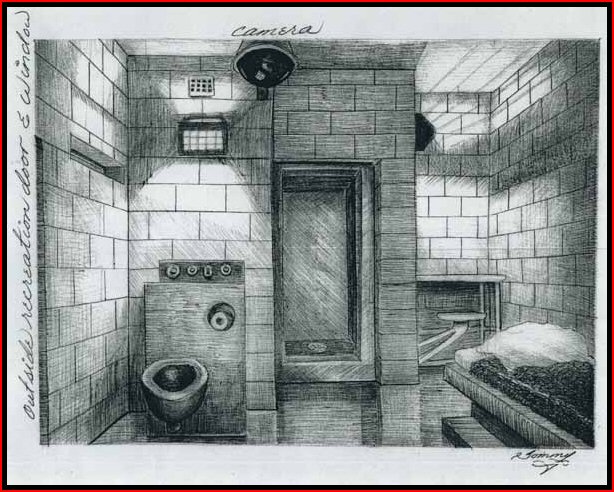
Drawings by America’s most isolated prisoner, Tommy Silverstein. More of him and other links below.


Shackled justice: Florence federal penitentiary and the new politics of punishment.


"All of us share a common curse," bemoaned President Clinton as he urged the passage of his fledgling crime bill. "In the most wonderful country in the world, we have the highest violent crime rate, the largest percentage of our people behind bars" (Denver Post, April 15, 1994). As with other U.S. leaders, however, the "New Democrat" president could not be expected to address the fundamental social fissures that simultaneously foster a terrifying plague of violence while building an increasingly policed and criminalized society. Instead, Clinton's quizzical solution to crime and excessive incarceration, as he defines them, has been a retrenchment of the preceding regime - marginalizing still broader sectors of U.S. society and expanding the state's powers of coercion to control those subsequently labeled as criminal.

The overarching effects of this law-and-order strategy toward governance have already been catastrophic. The U.S. imprisons some 560 of every 100,000 citizens and the proportion increases each year (New York Times, October 28, 1994). While critiquing the broad impacts of an increasingly punitive state, however, it is also important to analyze its localized manifestations. It is crucial to study not only the social and political forces behind the new politics of punishment, but also their smaller-scale and largely autonomous institutions. The billions Congress and state legislatures allocate to law enforcement and incarceration create and maintain individual penal institutions, from local jails to federal prisons, each caught within the matrix of the dominant social order. Together they profoundly control the lives of more than 1.5 million individuals, yet they are largely hidden from public view and critique (New York Times, October 28, 1994). One such institution is the newly opened control-unit prison in Florence, Colorado.

The new supermaximum-security prison is actually one of four facilities, which together make up the largest federal prison complex in the United States. When completely filled in early 1995, the entire "campus" will incarcerate some 3,000 inmates in four institutions: a minimum-security federal prison camp, a medium-security federal correctional institution (FCI), a maximum-security United States penitentiary, and an administrative-maximum, control-unit prison (ADX).

It has been an economic boon for economically depressed central Colorado and the prison promises 750 permanent jobs to this small, rural community. Florence has been long strapped by factory layoffs and throughout the 1980s most local families earned less than $15,000 a year (O'Keeffe, 1991a: 1; Bureau of Prisons, 1989: II-40). Already accustomed to a number of state prisons in the area, the town lobbied hard for the complex. A local newspaper poll found 97% support for the project, and despite the area's meager resources, Florence pulled together an attractive incentives package (O'Keeffe, 1991a: 1). Local citizens held bake sales and sold T-shirts, raising $128,000 to purchase land for the economy-boosting site (Denver Post, May 17, 1991). It is not often that a community asks for a prison to be built next door, and as the Bureau of Prisons (BOP) scrambled to contain a soaring prison population, it eventually accepted their offer. Construction of the $222 million compound began in 1990 (Denver Post, October 27, 1994). Today Florence's Fremont county boasts the highest concentration of inmates in the United States.


While prison officials and local residents found a convergence of interests in Florence, prisoners and their advocates are not nearly as enthusiastic. Activists for human rights and social justice are especially concerned about the ADX control unit, slotted to become the highest security and most regimented prison in the United States. The Bureau of Prisons designed Florence as a high-tech replacement for its infamous lock-down prison in Marion, Illinois. After a decade of stinging lawsuits and public protest there, the prisoncrats promised a kinder, gentler supermaximum prison in Florence. As the 554-cell men's control unit began to accept prisoners in early December 1994, however, all indications are that the prison will not reform the punitive Marion model of total isolation and sensory deprivation, but will intensify it. For those concerned with social justice, an understanding of the new prison and the gamut of policies it embodies is crucial. Florence represents the cutting edge of U.S. social control. Not only will dozens of incarcerated political activists likely be moved to the prison, but its construction also underlines the government's reaction to infrastructural decay and a growing domestic underclass.

The Marion Model

The Marion model for control-unit prisons originated within the Bureau of Prisons some 30 years ago. At a 1963 conference in Puerto Rico, prison administrators sought to cope with the closure of Alcatraz by dispersing "problem prisoners" throughout the federal system and experimenting with psychological rehabilitation programs (Ward and Carlson, 1994: 3). With the rise of national liberation movements, however, and especially after the Attica uprising of 1971, U.S. power brokers soon missed the ability of Alcatraz to isolate and rigidly control those who most articulately and effectively opposed their role. In an era of Increasing economic stratification and civil disorder, they moved to create embryonic institutions of social control for whatever perilous conditions the future might hold.

At Marion, the Bureau of Prisons began by reconcentrating high-security inmates in a new long-term control unit and forcibly enrolling them in the systematic Control and Rehabilitation Effort (CARE) (Dowker and Good, 1993: 2). With this behavior modification experiment underway, Marion became the "end of the line" for federal prisoners. By the dawn of the Reagan era, when warden Harold Miller assumed the helm, Bureau of Prisons' plans were already underway to convert Marion into a permanent isolation facility (Dunne, 1992: 40). It was a gradual transformation, and as prisoners resisted the erosion of their already limited civil rights, prison administrators justified each new step. After a long 1980 work strike, for example, the Bureau of Prisons permanently closed Marion's prison factory. The atmosphere became increasingly coercive and as guard violence, religious persecution, and other maladies increased, Warden Miller began the final crackdown.(1)

The immediate pretense was a series of murders inside. On October 22, 1980, prisoners in the control unit separately stabbed two guards to death. Four days later, a prisoner was found murdered in his cell (Dowker and Good, 1993: 3). Although two perpetrators were brought to trial and convicted of murder, Miller placed the entire prison under a state of emergency on October 28. The Bureau of prisons transferred riot squads with names like the "A-Team" and "Blue Thunder" from other prisons and a comprehensive shakedown began on November 2 (Dunne, 1992: 52). With every prisoner locked 24 hours a day in solitary cells, guards began a veritable reign of terror more violent than anything since the Attica rebellion. Guards in full riot gear removed their name tags and moved cell by cell through the prison, extracting and beating inmates and confiscating their property (Amnesty International, 1987: 1).


The case of Garvin Dale White is a poignant example. After refusing a rectal examination during the crackdown, he was beaten, forcibly x-ray searched, and locked naked in a "dry cell," with no heat, water, or toilet for four days. He was manacled the entire time (Dunne, 1992:53). Overall, there were 110 complaints of physical abuse filed, none of which resulted in legal or personnel disciplinary action (Ibid.).

After several weeks of total lockdown, Marion settled into its present conditions. It has served as the cutting-edge model for control-unit prisons ever since, dispensing entirely with the seemingly anachronistic rhetoric of rehabilitation and linking punishment to every aspect of prisoners' lives. Today, Marion prisoners spend 23 hours each day in their cells alone. There are limited educational and religious services, no central library, and no job-training program. In the most controlled cell block, inmates are allowed only one 10-minute phone call each month, three showers per week, and they can never move from their cells without shackles and handcuffs. At any sign of resistance, the prison's Special Operations Response Team (SORT) uses "whatever force is necessary" to restore order, including chaining prisoners to their beds for days at a time (ABC's "20/20," 1988). All this is at the cost of $40,000 per prisoner every year. "Marion is an experiment," Chicago Lawyer Jan Susler comments, "to see how much a prisoner can take before he breaks, to see how far they can dehumanize somebody before they completely lose their sanity" (Washington Post, May 28, 1991).

The effects of Marion and other control units on prisoner psychology are predictably profound. As early as 1890, the U.S. Supreme Court ruled that extended solitary confinement was "infamous punishment," leading to severe mental impairment (Haney, 1993: 5). More recently, the American Journal of Psychiatry reported significant psychological problems after less than two months of solitary confinement. Their observations, made at the Walpole Massachusetts Control Unit, included hallucinations, anxiety attacks, memory and concentration lapses, problems with impulse control, self-mutilation, and other diagnosable disorders (Grassian, 1983: 1450-1454). An Iowa prisoner in his fourth year of segregation wrote, "I remember waking up...so full of stress that the veins in my head were vibrantly flexing...like muscles having an involuntary spasm" (Stewart, 1990).

Conditions in the Security Housing Unit (SHU) of California's Pelican Bay prison are so severe that Harvard psychiatrist Stuart Grassian characterizes their effects as a unique illness (Bierma, 1994: 26). In accordance with a federal class-action lawsuit against the prison, Grassian interviewed 50 Pelican Bay inmates last year. He testified that 80% of them suffer from what he calls "SHU syndrome," in which they either become mentally ill once in the unit or their preexisting disorders are severely exacerbated. "Many of the inmates at Pelican Bay were among the most severely ill of people I've encountered in my research and observation," Grassian says. Pelican Bay does not rehabilitate. Instead, Grassian explains, the prison "takes the most out-of-control of the prison population and makes them much more out-of-control by the time they leave" (Ibid.). An isolation prisoner inside the unit writes, "It's like we're dead.... They've taken away everything that might give a little purpose to your life" (Haney, 1993: 5).


The newest facilities are unique in their application of sophisticated technology to control prisoners' routines, movements, and even thoughts more than ever before. At Pelican Bay, for example, electronic surveillance, automatic doors, and intercoms have replaced many guard duties. Silence reigns at the futuristic SHU where prisoners never see natural light and are prohibited from decorating their windowless cells (Weinstein and Cummins, 1993: 39). In a new supermaximum facility run by the State of Colorado, lights stay on around the clock and a single 3.5 inch by 3.5 foot window provides narrow vistas of a brick wall (Daily Camera, 1993).

Of course, it is not only technology that confines control-unit inmates; the threat of physical violence is a constant component in institutions of such rigidity. Inmates can be "extracted" from their cells by SORT teams for any number of reasons, including insolence, excessive noise, refusal to eat, and other infractions. Other times guards may shackle inmates to their beds, and reports of beatings and assaults with rubber-bullet guns are not uncommon (testimony at the National Lawyer's Guild Convention, August 1994). Most attacks result in relatively minor injuries that the prison hierarchy can easily ignore, but occasionally the inherent violence of control units spills beyond the confines of invisibility.

On April 22, 1992, for example, Vaughn Dortch was stripped naked and pulled out of his cell by a Pelican Bay SORT squad. According to court records, prison guards then carried Dortch shackled and gagged to the infirmary where six guards pressed him into a steel tub of scalding hot water for several minutes. Dortch, who is African American, told "60 Minutes" that the guards promised to give him a "Klan bath" and scrubbed him with a bristle brush until his skin started to peel away. "Looks like we're going to have a white boy before this is through," one of the assailants joked. Dortch received second and third-degree burns over 30% of his body (Bienna, 1994: 26).

Even without considering such wanton acts of violence, Amnesty International and Human Rights Watch have condemned such control units based on their design and purpose alone. In the Pelican Bay case (Madrid v. Gomez), U.S. District Judge Thelton Henderson ruled on January 13, 1995, that the California Super-Max violates constitutional guarantees against cruel and unusual punishment. "Dry words on paper cannot adequately capture the senseless suffering and sometimes wretched misery that [state officials'] unconstitutional policies leave in their wake," Henderson wrote in his 345-page decision. "The anguish of descending into serious mental illness, the pain of physical abuse or the torment of having serious mental needs that simply go unmet is profoundly difficult, if not impossible, to fully fathom" (Associated Press, January 14, 1995). Despite his harsh words, Judge Henderson's ruling was unfortunately narrow, limiting legal action to ameliorating inadequate medical care rather than addressing the policies of the control unit as a whole. Meanwhile, the Marion model continues to expand rapidly.(2) By 1991, there were control-unit prisons in 36 states, isolating over 18,000 people, and nearly every state has plans for further construction (Daily Camera, August 29, 1993).


The Crime of Punishment

The steady deterioration in U.S. prison conditions has not occurred in isolation. After a decade of Republican rule and economic stratification, it is only natural that the decay and violence on the outside would be magnified within prison walls. Between 1980 and 1990, the richest one percent in the United States saw their after-tax income grow by nearly 90%, while the majority sank into unemployment and growing poverty (Sklar, 1991: 10-12). Such statistics reflect the economic misery of millions of North Americans, sparking the rage and alienation that institutions like Florence scramble to control. As neither Reagan nor Clintonomics care to address this economic underdevelopment, their policies favor social control over social reform.

Reagan launched the "drug war" in the early 1980s and mainstream politicians have jumped on the increasingly coercive bandwagon ever since. Capitalizing on real public victimization, especially that in poor, urban communities, Congress and state legislatures have passed dozens of "get-tough" crime bills, imposing limitations on legal appeals, mandatory sentencing guidelines, more money for police with liberalized mandates, and especially for more prisons. While debating the federal crime package, Senator Joseph Biden described the prevailing zeitgeist: "There is a mood here that if someone came to the floor and said we should barbwire the ankles of anyone who jaywalks, I think it would pass" (Denver Post, November 10, 1993).(3)

California alone has enacted more than 1,000 crime laws since the 1970s, and its prison budget now eclipses funding for the University of California system (Denver Post, May 15, 1994). There are now 28 prisons in California, but if the state is to comply with the much touted "three-strikes-and-your-out" legislation, the state will need at least 20 more prisons by the end of the century. If the current incarceration growth rate continues, the state will need an additional 80 prisons over the next 30 years. The cost to California tax payers will be at least $24,000 per prisoner per year after construction costs, some of which will be spent for the entirety of prisoners' lives (Denver Post, May 15, 1994).

The results of this mostly bipartisan crime strategy, pursued through a string of administrations and congressional sessions across the country, are staggering. The United States now incarcerates at a higher rate than any country except Russia, and new crime legislation makes room for thousands more (New York Times, October 28, 1994).(4) Indeed, the medium- and maximum-security facilities at Florence and every new federal prison built are already filled beyond capacity (Bowers, 1993: 7).


This phenomenal growth, almost tripling since 1980, has little to do with crime. In fact, while politicians have polished their cavalier images, crime statistics have generally fallen or remained static. The two-decade National Crime Victimization Survey, for example, indicates a 29% drop in crime across the United States since 1974 (Bureau of Justice Statistics, 1993). For violent crime in specific, the rates have remained relatively flat, certainly representing elevated totals compared to most of the world, but hardly indicative of a new and escalating crisis.

Moreover, contrary to conventional media wisdom, the primary victims of crime have remained constant throughout the shift in U.S. crime policy. The only demographic group to actually suffer an increase in murder and other violent crimes over the last 20 years, for example, are urban teens, especially African American youth (Ibid.). For children, women, and almost everyone else, the most dangerous places in North America are still the home and workplace. There, reported rates of domestic violence, marital and acquaintance rape, and sexual assault and harassment remain epidemic. Domestic violence is the number one cause of injury to women aged 15 to 24, representing an impact greater than that of auto accidents and cancer combined (Denver Post, July 31, 1994). Most socially and environmentally egregious activity, especially that involving legitimized corporate pursuits, is not even defined as criminal.

These domestic and profiteering perpetrators have not been the focus of the anti-crime movement because addressing crime and violence is not its primary objective. Instead, the latest law-and-order regime traces its roots to politics and social control. As Marc Mauer of The Sentencing Project reminds us, "the politics of [crime] shows the data don't have much impact on the debate" (Denver Post, May 15, 1994). Yet the rhetoric of obfuscation has proved an incredibly effective political strategy for Democrats and Republicans alike, falsely diagnosing social maladies from painfully real symptoms and deflecting attention from the country's more deep-rooted and tangible concerns.

For people of color and others living in marginalized communities, the fear of crime victimization is compounded by the fear of police forces that function more as armies of occupation than keepers of the peace. People of color are not only the primary victims of crime, they are also the primary targets of the new law-and-order regime. They face discriminatory treatment at every level of the criminal justice system, from police harassment and brutality to racially charged congressional legislation and hostile Supreme Court rulings.


Throughout the 1980s and early 1990s, racial disparity in the judiciary has only deteriorated. In 1984, the average prison sentence was 28% higher for African Americans than for whites. With the escalation of the "drug war," the disparity grew to 49% by 1990 (Meierhoefer, 1992: 20-21). Mandatory sentencing guidelines, ostensibly designed to alleviate such penal subjectivity, have actually exacerbated the situation (McDonald and Carlson, 1993: 177). In 1990, Latino offenders were 28% more likely than whites to receive mandatory sentences (Vincent and Hofer, 1994: 24). Once they are in prison, people of color are the last to leave. African American women, for example, are eight times more likely to be sentenced to prison than white women and they serve 30% more time once inside (Kurshan, 1992: 346).

Such oppressive conditions, both inside and outside the prison system, have always sparked popular resistance that institutions like Florence are designed to control. Like Marion and Alcatraz before it, the Florence ADX is likely to hold those imprisoned for their political actions and beliefs: lifelong activists for Puerto Rican independence, Native American sovereignty, Black liberation, and anti-imperialism. The prison system treats these activists with special severity. Despite claims by the Bureau of Prisons that control units are designed for dangerous inmates incapable of coexisting in the general population, political prisoners often face isolation with no disciplinary charges against them whatsoever. When Silvia Baraldini, Alejandrina Torres, and Susan Rosenberg were sent to the Lexington High Security Unit (a rigid control unit for women isolated 30 feet below ground), prison staff informed them that their pass into the unit was "one way" unless they changed their political affiliations (Rosenberg, 1992: 128).(5) The new Florence ADX warden, Jim Story, admits that prisoners will be sent to the control unit for being the "leader or significant participant in a work or food strike" (Story, 1994a).

The Florentine Solution

Prison officials and their media supporters have tried to distance Florence from its problematic predecessor and accompanying political baggage. Administrative maximum facilities, they say, are an unfortunate necessity, housing only the most "predatory" criminals (Bureau of Prisons, 1992: 1). They offer mostly anecdotal evidence, emphasizing details of proverbial prisoner brutality rather than case studies or statistical data. The Denver Post, for example, introduced the ADX with mug shots of Manuel Noriega, John Gotti, and assorted neo-Nazis and serial killers (Denver Post, May 17, 1992). Thus, prisoncrats leave the impression that only the "worst-of-the-worst" will ever reach the ADX. By concentrating such super criminals in a single prison, a Bureau of Prisons Congressional Affairs memorandum argues, they decrease violence throughout the prison system (Bureau of Prisons, 1992:11-14).

As proof of their benign intentions, the Bureau of Prisons claims that most inmates have been downgraded from Marion since the 1983 lockdown. The 21 original prisoners who still remain, of course, have been locked down now for more than a decade (Ibid.: 9). Contrary to Bureau of Prisons assertions, shipment to an ADX requires less than grisly stardom. In fact, the designation of a prisoner's security level is an arbitrary process, and anyone who antagonizes prison officials, through prison organizing, legal work, verbal defiance, political affiliation, or, more rarely, through actual violence, can be labeled an acute security risk. Dan Dove, Chief of Bureau of Prisons Public Affairs, concedes that there is no judicial oversight in determining who will be sent to the Florence ADX. "Inmates may be represented by a staff member at these hearings," he writes, "but there is no provision for attorney representation" (Dove, 1993: 3). A 1985 congressional report on this wholly internal process determined that 80% of Marion inmates merited a less severe security rating (O'Keeffe, 1991b: 13).


Prison officials assert, however, that Marion is perfectly fair and operates within constitutional guidelines. (They make no mention of international guidelines.) Florence, they say, will be even better. Unlike Marion, the new ADX is designed as a supermaximum prison. Bureau of Prisons literature cites new technology as the key, allowing Florence to function securely without bed restraining loops and standard shackling for any movement. Like Marion, Florence will operate on various security levels, ostensibly allowing inmates to work their way toward release through long-term cooperative behavior (Dove, 1992: 2).(6) During construction, Florence project manager Russ Martin summarized the Florence Renaissance approach: "The entire design of the facility is to create a more humane environment, to take away the dungeon effect" (O'Keeffe, 1991b: 13). Reading Bureau of Prisons media releases, one almost envisions Florence, where cells are "rooms" and inmates work toward completion of their "institutional careers," as a beacon of New Age corrections. October 1993 was even "Hispanic Heritage Month" at the prison (FCI/FPC Florence, 1993: 1).

A glance inside is more reminiscent of the rack. The Florence ADX penitentiary sits in the southeast corner of the four-prison complex. It is an imposing triangle of X-shaped cell blocks, surrounded by double 20-foot fences interwoven with 10 rows of razor wire.(7) Two perimeter roads, 8,000-watt lights, microwave sensors, anti-escape trip wires, and six sniper towers separate the ADX from the other facilities. Prisoners are unlikely ever to reach this dead space since the prison walls themselves serve as the primary perimeter, containing the limited recreation areas and everything else. Guards and visitors enter the prison through a tunnel.

Countering charges of sensory deprivation, Bureau of Prisons officials always note that Marion's cells close with open bars, allowing communication and free air flow (Bureau of Prisons, 1992:4). They have eliminated even this vestige of humanity at Florence. Cells in the six isolation units measure less than 90 square feet each and lock with a solid steel door (Bureau of Prisons, 1994: 2). Each cell contains a three-foot-wide cement bed slab, a concrete stool and desk, a steel sink and toilet, and a three-by-three shower stall. A fluorescent light panel glares from the wall, illuminating other amenities like an electric cigarette lighter, an inmate duress switch (since the cells are essentially soundproof), an air grate, and, in some cells, a small television. Double doors shrink the cells by another three feet, trapping unreachable space between bars and the outer door. Only two window slits allow external light into the cage, one on the steel door staring into the empty hallway and another body-length sliver facing an empty courtyard. The shower, along with food slots in the door, allow for total isolation. Even psychological counseling can be a solitary experience in the ADX. Warden Bill Story promises that health care will be "consistent with community standards" and that those inmates deemed too dangerous to leave their cells can receive religious or psychological guidance from "professional staff" over closed-circuit television (Story, 1994b).

When and if prisoners are allowed out of their cells, they will have little to celebrate. Visits in the control blocks will be tightly regimented and only allowed through Plexiglas dividers. There will be no joint religious services of any faith and educational programs will be restricted beyond GED work (Dove, 1992: 3). Not even demeaning work assignments will break the monotony of isolation for most of the prisoners (Ibid.). In the worst units, inmates will exercise alone in a pod barely twice the size of their cages, some for only five hours per week (Bureau of Prisons, 1994: 3).


Thus, the Florence ADX's very layout determines that it can be nothing but a chamber of sensory deprivation, designed to press inmates to the brink of insanity by its very architecture. Modern electronics allow constant surveillance and supervision while prisoners themselves remain physically invisible, locked away from any direct human view or contact in compartments of solid steel.

Prisoners arriving en masse from Marion are finding many of their worst fears confirmed. While Marion was a uniquely despised locale, some newly arrived prisoners find themselves expressing an ironic and disturbing nostalgia. One prisoner wrote in early January:

It could be said that I've gone from the cauldrons of Hell in Marion right into Hell's fire in Florence. In Marion prisoners had access and gave support to each other. Even though it was limited to the unit, there was solidarity among prisoners. And at least once a week prisoners had access to the yard, where there was grass and from where we could see the forest, birds, and once in a while, a deer. But the Florence ADX is a cement and steel box designed for sensory deprivation.(8)

Though there were just over 50 inmates (out of an anticipated population of at least 484) in the ADX at the end of 1994 and prisoners remain optimistic that Florence guards may prove themselves to be more professional than their Marion counterparts, reports of staff abuses have already surfaced. Prisoners complain of repeated strip searches before and after visits (despite the absence of physical contact with anyone except prison staff), excessive shackling for any movement, and intentional sleep deprivation, with guards waking some prisoners every hour throughout the night. "The reality of sleep and sensory deprivation supersedes anything I've ever seen," writes a new arrival from Marion, "and that includes Pelican Bay."


Trapped in Toxicity

Florence shares not only cruelty with Marion, but also its environmental woes. At Marion, contamination surfaced as early as 1984, when the Environmental Protection Agency (EPA) placed Crab Orchid Lake, a nearby water source, on its National Priorities List for Superfund cleanup (Rocawich, 1989: 24). Elevated PCBs and other toxins convinced the town to switch to an alternate water supply and guards began carrying bottled water to work (Ibid.). As the prison constituted a "community" of less than 10,000 people, however, it fell outside national safety guidelines. In addition to the PCB's, banned in 1976 because of their excessive toxicity, EPA tests found other carcinogens in Marion's water, including chloroform and trihalomethanes (Berkman and Clapp, 1989: 1). In 1986, chloroform levels were more than a thousand times higher than established safety limits (Ibid.: 2). However, Marion administrators took no action on behalf of the prisoners until 1992, consistently denying any contamination or safety risks (Bureau of Prisons, 1992: 18). Meanwhile, for over a decade Marion prisoners consumed contaminated water every day. Several prisoners and their supporters filed lawsuits against the prison, including Robert Wyler, who has since died of kidney cancer (Ibid.: 2-3).

Marion's history of environmental neglect may foreshadow similar events at Florence. Five miles due west of the new prison complex lies the Cotter Uranium Processing Facility, another EPA Superfund site. Cotter began operating the mill in 1958, processing uranium ore into purified uranium oxide "yellowcake" (Ibid.). Cotter stored the cakes - including original Manhattan Project ore with some of the highest concentrations of Thorium-230 and Protactinium-231 known - in giant, unlined tailings ponds (Dodge v. Cotter, 1991: 3). Later, after the ponds were lined, there were over 70 leaks reported at Cotter between 1980 and 1986 (Colorado Attorney General's Office, 1986: 3-28). Until its suspension of operations in 1987, Cotter accumulated approximately 3.5 million tons of radio-active tailings, storing them over 135 acres near Canon City and Florence (Dodge v. Cotter, 1991: 4).

The surrounding communities suffer contamination both through their water and air. Toxic compounds leak into the underground water supply through the unlined ponds and also into the Arkansas River. According to a state-commissioned investigation, the nearby housing development of Lincoln Park has radioactive levels 2,000 times higher than normal background amounts (Colorado Attorney General's Office, 1986: 4). During the irrigation season, the Cotter drainage spills into the Fremont ditch, floating radioactivity directly toward the Florence water supply (Ibid.: 6-11; 6-18). Studies along the Fremont ditch found elevated levels of molybdenum, arsenic, lead, and other contaminants. Molybdenum levels were even higher than those much closer to the mill site (Ibid.: 6-19). Additional allegations that Cotter may have dumped tailings and other waste down abandoned mine shafts to circumvent federal safety standards raise the specter of even worse contamination, perhaps of the entire aquifer (Cotter v. Dodge, 1991: 6).(9) The Bureau of prisons, final Environmental Impact Statement worries that the prison's water supply may have to be rerouted in the future due to "pollution" problems (Bureau of Prisons, 1989: II-45).


The mill also endangers the surrounding communities and the prison population with airborne particulates. Cotter itself estimates that over 19.9 tons of radioactive dust escaped the plant during each year of its operation. In the arid plains, these particles are especially mobile and the prison lies directly in Cotter's secondary wind pattern, subject to gusts of radium, uranium, thorium, and other grains (Colorado Attorney General's Office, 1988). Cotter's continual negligence, even to the point of spilling tailings from railroad cars in downtown Canon City, has prompted several lawsuits on behalf of the EPA and state and local residents ("EPA Eyes Cleanup of Radioactive Soil," 1991). In 1988, Cotter settled a $550 million government suit out of court and has agreed to finance its own cleanup under state supervision. In February 1994, a federal jury awarded $80,000 to eight Lincoln Part plaintiffs for claims associated with the site (Daily Camera, February 17, 1994). There have been no suits filed on behalf of Florence prisoners and since carcinogens may take years to complete their work, any court action may be long delayed.

That the government has expressed little concern for prisoners' environmental safety (or even that of the guards) should come as no surprise. Dozens of prisons have even worse environmental records. The Michigan State Prison in Jackson, for example, was fined $160,000 for illegally storing DDT and Agent Orange (Elvin, 1991: 13). At the state prison in Florence, Arizona, a visiting room sign warns: "If you are pregnant or of childbearing age, do not drink the water" (Ibid.).(10) In these actions, federal and state prisons only mimic corporate behavior across the country, dumping their waste based on a given community's resources and ability to respond. Consequently, prisoners, people of color, and poor communities like Florence bear the brunt of environmental degradation.

Cracks in the Bastille

Prisoners and prison activists have not accepted human rights violations, racism, and toxic exposure quietly. Only a few months after the minimum security camp opened in Florence, inmates organized a food strike to protest inadequate services at the new prison. The largest disturbance at Florence to date came in late February 1994, when medium-security prisoners rioted for several hours, smashing windows and computer equipment, and setting small fires throughout the building (Daily Camera, March 1, 1994). Prisoners at Florence and other federal institutions warn that overcrowding, continual harassment, and ever-harsher sentencing have pushed prison populations to the brink of explosion.

The tensions of overcrowding and mismanagement have affected prison staff as well. Nineteen Florence employees asked for a federal investigation into racial harassment at the prison in October 1993. Four of the whistle-blowers, all African Americans, have since been disciplined by FCI warden Tom Wooten. Charging the four with dubious rules violations, Wooten placed them on indefinite paid suspension and has refused further comment on the case and other management complaints (Rocky Mountain News, February 27, 1994).


I don't know what to make of this; bizarre, imagination, or a sense of humour? Or none of these.

Controversy has erupted on the outside as well, and organized resistance to prison racism and control units has escalated steadily over the last two years. The Committee to End the Marion Lockdown (CEML), founded in 1985 to oppose Marion abuses, has shifted much of its focus to Florence and produces information packets and visits Colorado several times. Committee activists visited Pueblo, Colorado, and surrounding communities as early as 1988 to oppose the ADX construction and to network with local human rights activists.

In Colorado, various organizations formed a statewide coalition to oppose control-unit prisons and political imprisonment in 1992. Labeled Abolish Control Unit Torture (ACUT), the coalition publishes a bimonthly newsletter, serves as an information clearing house, and organizes demonstrations, speaking tours, and other community events.

In October 1993, ACUT and the Movimiento de Liberacion Nacional Mexicano (MLNM) invited former political prisoner Rafael Cancel Miranda to Colorado to lead a demonstration at Florence. Cancel Miranda, along with three other Puerto Rican nationalists, spent 25 years in the worst U.S. prisons, from Alcatraz to Marion, for a 1954 attack on the U.S. House of Representatives.

Over 300 people converged at Florence on October 23, 1993, for a mass rally and march to the prison gates. In addition to the activists from across Colorado, several vans arrived from Chicago as well, carrying representatives of the CEML, the National Committee to Free Puerto Rican Political Prisoners and POWs, and relatives of several Marion prisoners. As the demonstration concluded, Cancel Miranda pointed to police and prison guards, urging them to realize their positions as pawns in oppression. "Florence was built for all of us," he said, and "while it stands, none of us are free."

At the National Lawyers Guild 1994 convention in Albuquerque, prison activists from around the country gathered to share information and strategy. Planned for the future is an on-line control-unit information network, long-term research and legal assistance projects, and a national day of action in Washington, D.C., scheduled for July 17, 1995. Working to coordinate the Washington demonstration and to form a comprehensive control-unit monitoring project, organizers held a national conference in Philadelphia in early December 1994. In Colorado, activists kept up the pressure as the ADX opened surreptitiously in early December, holding a large regional rally at the prison gates on December 10.

Resistance to the Florence supermaximum prison will continue as the U.S. prison population swells. It is projected to surpass two million human beings as anti-crime hysteria swings the political mainstream to the racist right. The Florence ADX is the quintessential embodiment of this oppression, destroying individual spirits through isolation terror and locking broad issues of social justice together within its gates. It represents the denial of justice to everyone in the United States - especially people of color and the poor - through environmental destruction and negligence, obfuscation of the real socioeconomic roots of crime, and political violence against those who dare to resist. The fight against Florence, therefore, is more than a struggle for individual human rights and dignity; it is a struggle for our collective survival. As Malcolm X summarized prison politics in the United States, "Don't be surprised when I say I was in prison. We've all been in prison. That's what America means - prison." The Free Library + notes and refs


Solitary: The Works of Tommy Silverstein


http://tommysilverstein.blogspot.com/

http://artofsilverstein.blogspot.com/

America’s “Most Isolated Man” Sues the Bureau of Prisons

Judge tosses suit of inmate long held in solitary

http://www.supermaxed.com/Federal-SM-Page.htm Everything you wanted to know about man's inhumanity to man. (both ways I guess)

Confronting Torture in U.S. Prisons: A Q&A With Solitary Watch