Showing posts with label Civil Rights. Show all posts

Thursday, August 28, 2014

Justice #USA America’s Corrupt Institutions


I don't know how many of you reading this, truly understand how the US Justice System really functions? Well it functions just like Paul Craig Roberts says it does, shamelessly corrupt and about as far away from justice as is possible to be.

I am just featuring the first part of Craig Roberts article, the non-specific part, the part where to be alone charged with a felony, leads inevitably to a conviction. It is that simple. It is that frightening.


America’s Corrupt Institutions

Paul Craig Roberts
August 27, 2014

Every public institution in the United States and most private ones are corrupt.

To tell this story would be a multi-book task. Lawrence Stratton and I have written one small volume of the story. Our book, The Tyranny of Good Intentions, now with two editions and multiple printings, documents the corruption of law in the United States and has been cited in rulings by Federal District and Appeal Court judges.

Law is just one public institution, but it is a corner stone of society. When law goes, everything goes.

Only about 4 percent of federal felony cases go to trial. Almost all, 96 percent, are settled by negotiated plea bargains. Law & Order Conservatives condemn plea bargains for the wrong reason. They think plea bargains let criminals off easy.

In fact, plea bargains are used by prosecutors to convict the innocent along with the guilty. Plea bargains eliminate juries and time-consuming trials, that is, plea bargains eliminate all work on the part of prosecutors and police and lead to high conviction rates for prosecutors, the main indicator of their career success. Once upon a time, prosecutors pursued justice. They carefully examined police investigations and only indicted suspects whose conviction they thought could be obtained by a jury. Sloppy police work was discarded.

No more. Once indicted and provided with a lawyer, the defendant learns that his lawyer has no intention of defending him before a jury. The lawyer knows that the chances of getting even a totally innocent defendant found not guilty is slim to non-existent. Prosecutors, with the consent of judges, suborn perjury for which they are permitted to pay with money and dropped charges against real criminals, and prosecutors routinely withhold evidence favorable to the defendant. If a prosecutor detects that a defendant intends to fight, the prosecutor piles on charges until the defendant’s lawyer convinces the defendant that no jury will dismiss all of so many charges and that the one or two that the jury convicts on will bring a much longer sentence than the lawyer can negotiate. The lawyer tells the defendant that if you go to trail, you will be using up the time of prosecutors and judges, and the inconvenience that you cause them will send you away for many a year.

In some state and local courts it is still possible on occasion to get an almost fair trial if you can afford an attorney well enough connected to provide it. But even in non-federal courts the system is stacked against the defendant. Many prisons have been privatized, and privatized prisons require high incarceration rates in order to be profitable. The same holds for juvenile detention prisons. Not long ago two Pennsylvania judges were convicted for accepting payments from private detention prisons for each kid they sentenced.

Judges prefer plea bargains despite the fact that plea bargains amount to self-incrimination, because plea bargains dispense with time-consuming trials that cause backed-up and crowded court dockets. Trials also demand far more work on the part of a judge than accepting a plea bargain.

The fact of the matter is that in America today you are expected to convict yourself. Even your lawyer expects it. The torture is not physical; it is psychological. The system is severely biased against the defendant. Conviction by a jury brings a much heavier sentence than conviction by a deal that the defendant’s attorney negotiates with the prosecutor’s office. All the prosecutor wants is a conviction. Give him his conviction for his record as an effective prosecutor, and you get off lighter.

The injustice lies in the fact that the rule applies to the innocent as well as to the guilty.
The prosecutor and often the judge do not care whether you are innocent or guilty, and your lawyer knows that it does not matter to the outcome.

The police have learned that such a small number of cases go to trial that their evidence is seldom tested in court. Consequently, often police simply look for someone who might have committed the crime based on past criminal records, select someone with a record, and offer him or her up as the perpetrator of the crime. This police practice is one explanation for high recidivism rates.

In the totally corrupt American criminal justice (sic) system, anyone indicted, no matter how innocent, is almost certain to be convicted.

Let’s take the case of Alabama Democratic Governor Don Siegelman. more


Lady Justice Wiki

Justice Wiki

Footnote: It was this very thing, the blatant injustice of the American system, that first galvanised me into my blogging "career."

Monday, July 14, 2014

Cecily McMillan Rikers Island and the Manifestation of American Exceptionalism


As you read the appalling details surrounding the behaviour of the staff at Rikers Island Jail, NY, you might, like I, wonder if this is just another manifestation of the much vaunted and self delusionary "American Exceptionalism"?

Itself being but a euphemism for the abuse of power, torture, the total disregard for civil and human rights, and as history has already demonstrated, a total disregard of life itself.

You may also, as I did often, wonder at the mindset of those employed, not just at Rikers Island, but throughout the seriously flawed correctional system as a whole.


Released Occupy Activist Cecily McMillan: "There's No Sense in Prison"
By Sarah Jaffe, Truthout | Interview
13 July 2014


Released from Rikers prison after serving 58 days, Occupy activist Cecily McMillan discusses prisons, policing and why she'll keep protesting.

Cecily McMillan would rather not be famous. Not for the dubious honor of receiving the most serious sentence among thousands of Occupy Wall Street activists arrested over the course of the movement.

McMillan was released from Rikers Island after 58 days. She'd been sentenced to 90 days for felony second-degree assault for elbowing a police officer, Grantley Bovell, who was attempting to arrest her as Zuccotti Park was cleared on March 17, 2012, but got out early on July 2 for good behavior. She still faces five years of probation and a life with a felony record if her appeal, which is still going forward, is unsuccessful.

At trial, McMillan argued that she accidentally struck the officer after he grabbed her breast, bruising her. She'd previously refused to take a plea deal that would still have resulted in her pleading guilty to a felony. The jury found her guilty - though later nine of the 12 jurors issued a call for leniency in sentencing.

Video of McMillan suffering an apparent seizure after her arrest, while officers looked on and did nothing, was not allowed at trial, nor was evidence of other accusations of brutality against Officer Bovell. Despite the jurors and several members of the New York City Council calling for McMillan not to serve prison time, the judge, Ronald Zweibel, remanded her to Rikers immediately after her conviction, rejecting her lawyer's request for bail. "A civilized society must not allow an assault to be committed under the guise of civil disobedience," Zweibel said at her sentencing.

Upon her release, McMillan brought to the press a statement from the women of Rikers that she met while inside, with a list of demands for reforms of the institution. Though, she says, she is nobody special - "I'm just not as interesting as they're making me out to be" - her experiences have made her determined to speak out about prison conditions, as well as the connections between the prison system and the economic justice issues that led her to get involved with Occupy in the first place.

McMillan spoke with Truthout's Sarah Jaffe about prisons, protests, policing and the world she'd like to see. This is an edited transcript.

Truthout: How does it feel to be out?

Cecily McMillan: It's very discombobulating. I remember coming home, sitting on my bed, looking at all my clothes. It took me literally 30 minutes - being almost paralyzed with decisions available to me - before I could even pick out something to wear around the house. I've been wearing the same two outfits, same two sets of pajamas, for 58 days.

It's like that with everything. Getting up in the morning and choosing what to eat. It took me a while to even get any sort of voice back. When I got out and did the press conference I had to start my speech over because I literally lost my voice. I had forgotten what it meant to be listened to.

I am really overwhelmed with the task of adequately representing the needs of the women in Rikers. I had the very real experience, but nonetheless, that was only 58 days. Many of these women have been in and out, sent back again and again. I take very seriously the task that they have given me to represent their conditions in Rikers and the resources they need in order to get out.

I really fiercely miss my family in Rikers. These are the women that really sustained me in there, that really kept me going, that really helped me to continue to stand up for the values that I believe in. There's a bond and an experience that I have with them that I don't really have in my community on the outside.

It sounds like you've been thinking a lot about the role you have now, the way you can use the attention given to your case that isn't given to so many other people who are in there.

I'm really uncomfortable with the concept of a martyr, the concept of a leader. As far as I'm concerned, I just got sexually assaulted, which is a really commonplace experience for women in this country. I just got targeted, which is a really common experience for people of color in this country.

I don't think that I'm particularly special or even the best person to advocate on behalf of the everyday life of, not if, but when most of these women will find themselves in jail. When they asked me to deliver their demands, when they wrote them down, when they handed me 50 little sheets of paper that I read out to my team over the phone, I realized that I had some idea of what their oppression was, but not a clear structural understanding. It has been a constant worry that I won't do them justice.

Any particular stories about what it was like there that you'd like to share?

Maybe the best way that I could explain is through describing a search. Our dorm gets randomly searched at least twice a month, more if they want to set an example or if somebody has been smoking in the bathroom or if there have been rumors that somebody had some sort of contraband.

They use this space more or less to haze the new [correctional officers]. Two or three captains, 10 or so officers file into your dorm in full riot gear, the whole Plexiglas panel that's surrounding their body, the masks and a huge wooden bat. Another set of officers file into the bathroom and stand in a line facing the stalls that don't have doors. The first time they did the search I was using the restroom and had to finish my business right in front of them. They direct everybody to get down on the beds face down with your hands behind your back, after you put on your uniform and your ID badge. In Rikers you become a number. I'm 3101400431.

A third set of officers file in through sleeping quarters. Sometimes they bring in dogs. They call you row by row into the bathroom to strip down completely naked, do a deep knee bend forward, a deep knee bend backward, then have you open your mouth and shake out your hair and lift up your breasts.

After that the row files into the day room, and they have you face the wall standing throughout what can take up to a three or four hour process. Again you have three or so different captains, yelling "Miss, Miss," and if you turn around they're like, "I said turn around and face the wall! You want me to take your good days away?" You don't know who's giving orders where. They direct you into the entrance room where they make you sit down on a metal-detecting chair to check your body for any objects that you may be concealing. You have to put your cheek on a similar body metal detector device.

Then they bring out the women row by row again to our beds where they have flipped your bedding over, and you're made to stand there and hold your mattress off the ground. These old women up to 80 years old having to stand there for hours and then hold their mattresses up like this. They page through everything. They turned to me at one point and said, "McMillan! Why do you have so many books?" I was like, "Because I'm a grad student! Are you looking for cigarettes or are you looking for radical literature?"

If a CO isn't being humiliating enough, a CO will come over and ravage through your things even more. They can take anything away. These little soap hearts - this inmate would crush down soaps and reform them into hearts and put little pictures from magazines on them. Anything besides two pairs of pajamas - shoes that you got medically cleared, any commissary, if you have more than one shampoo and conditioner, pens. It takes like two weeks to get one of those.

After that you're all marched back out and whatever doesn't fit on your bed becomes trash. They will have another set of inmates come in - this is the real dirty part - and sweep up all of your belongings into these big trash bags and when you're let back into your room, the closest thing I can describe it to is growing up in southeast Texas and coming back home after a hurricane to return with your community to put your life back together again.

All sorts of things can go wrong. My bunkie, the woman next to me, had very serious asthma and they woke her up like this; she had a very severe asthma attack, to the point that she nearly collapsed and they said, "Stand up, why are you sitting down?" I said, "She has asthma," and they yelled, "shut the fuck up!" and I said, "You're going to have a lawsuit on your hands unless you get her her inhaler," and they asked her, "Which bed are you?" and she couldn't talk. I said, "She lives right next to me, I can get her inhaler," and they said, "Shut the fuck up!" and then she started wheezing and they're like, "OK, McMillan, go get her inhaler, quick!" and I trot off, and they yell, "Don't run, walk!" This woman ended up having to go downstairs to get a steroid shot.

That's a normal experience at Rikers, something you have to accept. They can come at any time, any day, during any set of services, 3:00 AM, doesn't matter.

The statement from the inmates in particular focused on the lack of medical treatment given to prisoners, and I hear that again in this story.

I have to agree wholeheartedly - this will seem like the most unlikely ally - with the president of the Correctional Officers Benevolent Association, Norman Seabrook, who I worked with before. Rikers is not and should not be a mental institution. I read a recent statistic that said more than 40 percent of the women there have been diagnosed with mental health conditions and I would say that's an underreporting. Every inmate is not required to undergo a thorough psychosocial consult. These women need help. Actual resources. Not to be put in a place that will literally drive you mad if you were whatever sane was to begin with.

Beyond the mental health standards, it is the norm to go downstairs for clinic - you have to sign up for sick call the night before; if you don't sign up you don't go. Then you have to wake up somehow of your own accord at 6 AM to go prepare for sick call. You could be waiting up to two or three hours at the door for sick call because when the door closes you're not getting out. I never got through sick call in less than six hours; you could be waiting easily up to 12 hours, and you could also still not see a doctor and have to come back two, three or four days in a row.

Very basic things like a cold, an ulcer, think about it. These tiny little things that can be fixed with ease turn into death sentences, rapidly. I witnessed another woman who had stomach cancer who found herself in so much unbearable pain that she was just yelling out her bunkie's name for hours before medical finally came up and when they did, they refused to touch her and required her to climb up on the gurney herself and wouldn't allow us to help her climb up on this gurney. The gurney ended up going up on two wheels as she nearly careened to the floor.

People keep asking me what was the doctor's name. Doctors don't have to give you their names. And of course they won't.

It's not that I don't want to talk about Judith's death. I'm happy to talk about Judith's death in the sense that I would love for her death to actually have eyes. I would love for anybody to recognize that she died, but I want to really paint a picture that this isn't an anomaly.

Another girl, when she was brought in for intake, was given what she thought was a routine physical, where a doctor that is known to be - nasty is the term that they use to describe him, telling inmates in Spanish that these uptight nurses, what they really need is a good fuck. He told this inmate that he needed to do an exam, told her that her chromosomal count was off, that he needed to do an exam to determine if she were really a man or a woman, had her pull down her panties as he stroked her. With no female nurse present.

It didn't even come out until after I had left. They were talking about medical abuses in the dorm after I left, and she said "That doctor? He gave me a gynecological exam when I came in." Another inmate said, "He's not a gynecologist," and she said, "He said he needed to determine . . . " and it wasn't until she finished the sentence that she realized that there was anything even wrong with that.

It's just horrifying. This is the pervasive treatment that such a broad swath of our society experiences on the outside every day, that humiliation has become that normalized.

People promise all sorts of things to these wonderfully resilient women all of the time and they very rarely follow through. I don't think that they thought that their voices would actually be heard by so many. I was terrified that I was going to get out and nobody was going to want to hear what they had to say on the inside. There's a reason why we have such a beautiful piece of real estate being occupied by a prison-industrial complex; that's why they're way over there with a bridge separating them from the rest of society. It's easier for society to put those people over there so that they don't have to be reminded daily of the degrading terms on which our democracy rests.

I'm hearing this, thinking about the incident that landed you in Rikers in the first place. I wonder if you feel like all of this is related, the way the police behaved outside of jail and the way inmates are treated on the inside?

Maybe that's what has made me relate so much to these women and why I feel so alienated from the community I had before. There's so much love; people are so overwhelmingly supportive; my friends are just incredible; my entire Occupy family is just beautiful. But to have undergone the experience that I had was in a sense to remove me of my class privilege.

I know that there's an irony in saying that as I have the opportunity to talk to you right now, which obviously means that I still do have privilege beyond measure in a comparative sense. But it at least allowed me a glimpse into what it means to be targeted by the police, to be characterized as dishonest, as undesirable by the court system, to be remanded without bail, as only the most serious crimes are. I had to spend like a week in jail trying to convince people that I wasn't some sort of mass murderer. They said, "Did you miss a court date?" and I said "No," and they said, "How many people did you kill?"

This is a double-edged sword. I went into Rikers and rather than the example to be made for Occupy Wall Street and of all dissent, I was just a normal person in there and there was a certain comfort to that. Even amidst the shocking humiliation there's also a solidarity of human struggle that I had really missed. Just be amongst other people who had been targeted, who had been treated poorly, who had been lost in the justice system, there was something to be said for that. I feel like in some ways I had been removed of all personhood except for the political idea they had wished to make of me and somehow through Rikers I regained my personhood, in the most humbling and profound way.

You want to talk about really seeing firsthand these books we read about the feminine condition, class condition, racial conditions, there's nothing like spending time in Rikers to make you feel those words. Feel the reality of the new Jim Crow. Feel the vulnerability of what it means to be a woman. Feel the helplessness of being a part of an undesirable criminal class.

I read that even when they were letting you out, they took you somewhere you weren't expecting to be?

Captains do not talk to inmates. The captains make all the decisions, so if you want a decision made you have to go through a CO to talk to a captain and the captain doesn't address you; they talk about you in front of you and then the CO tells you. I was passed through like a dozen captains that morning starting at 5 AM, and you're never even brought down till 7:30 AM after the court folks have been put into transportation. I was brought down at 5 AM, people from property, people from medication were called in early that morning just to discharge me. I was discharged at 8:30 AM, put into a van and I said to the very nice CO, "Have you ever seen them try to get rid of somebody so quickly?" He said, "No, I've also never been ordered to chauffeur somebody to a train station." I said, "Wait, what, no no no, I'm supposed to go to the Perry building," which is where people wait for inmates to get released. My friends were there; I really needed to meet them because I don't have an ID, a phone, without anybody that I care about knowing where I am. Especially being disappeared for 40 hours without any access to a lawyer or anybody able to find me after the initial arrest I was like, "Oh God, what is happening here?" They can and do disappear people at Rikers Island.

I was terrified. What are you going to do at Rikers Island in cuffs, tell an officer who doesn't show you a badge, a name, "No thank you, I'd like to go back to my dorm now"?

I'm in this car, the CO says OK, let me talk to my captain. He calls the deputy warden over; I tell him I do not consent to being driven to an unknown location without ID, without phone, without keys, without talking to my friends, nothing. Once I have passed the gates of Rikers, you are no longer in charge; I demand to be let go. I sat there for about 40 minutes as I'm sure they called all the way up to the commissioner, and then the CO said, "I'm sorry, I have orders; my wife died a couple of months ago from cancer and I'm in charge of these two young boys and I can't lose my job; I can't lose my pension. If I disobey orders, I'm going to get in trouble. This is coming from all the way up."

He drove me to Queensboro and dropped me off with my package and my MetroCard and he did, I will say, wait around until I managed to find somebody with a phone before he drove off. Luckily there was a young man who recognized my jail bag with my numbers on it; he said, "You look really distressed; did you just get out of jail? Do you want to borrow my phone?" and I said, "Please." He turned out to be an activist for Chinese immigrant rights; he sat there and waited with me until my friends came and picked me up. They asked, "You're WHERE?" and I said, "I don't know!"

You get a real sense that you could die, that you could disappear, that anything could happen to you while you're in there. This is the reality that these women live every day.

New York has been going through a lengthy debate over the practices of the NYPD, which became central to last year's mayoral election. How would you like to see the NYPD changed?

As one inmate said in her own demands, "A full-on investigation of the protocols of the NYPD. I mean look at this place, you're one of two white girls I've seen in here."

I don't know how to say it better. The NYPD, I have no problem with the human beings themselves at all. I think that there is a way that a police force could actually be used to protect the citizenry. I would love to see police officers help, especially the elderly, help children in times of need, in times of chaos. I think that there could be a really valuable role for police officers in a human community. But what we have right now is specifically not that.

I think "Stop policing, start protecting" is a really valuable chant. We've got to ask, who is it that the police are accountable to? It seems to me very clearly that it's not the people. The bankers haven't been arrested. I would love to see, what is the total sum of money that every prisoner in Rikers has ever allegedly stolen as compared to the 2007 housing market crash.

In that sense, I do think that the NYPD as a force has become the arm of the corporatocracy. The way that they treated Zuccotti Park, the way that they go out and seemingly round up undesirable people, especially at times that gentrification is in full swing, but never happen to be around in times when the same people actually require assistance or help. What are our police doing? Why are they doing it? Who are they responsible to? Why don't we have more community oversight? Why don't we have a democratic hand in selecting the commissioner?

I found it ludicrous that one of the reasons why they were saying I was clearly not the victim of anything is because I didn't report it to the internal affairs bureau. "Hey, um, excuse me police officers, can I tell you about how this other police officer, your friend, comrade and coworker, abused me?" You've got to be kidding me. Who would do that?

This big disarmament facade of removing guns from our streets via racial profiling - where's your disarmament strategy on the other side? Why is it that every police officer needs a gun?

I heard the recent number of how many New Yorkers died by gunshot wounds in 2013. I want to know how many of those bullets were at the hands of the NYPD. I think the police need to be democratically controlled just as our state is supposed to be. If you look at the basic demands of the women in Rikers, they were just asking for the same rights and the same avenues to participate in their own fate as we have begged for in this country for as long as I've been alive.

I think that the platform and demands laid out by the women of Rikers give us some serious direction for our own democratic organization as well. How can we, the citizens of New York City, file a grievance when an officer has abused his duty? If it's not the officers, who can we hold accountable for issuing the order? How can we know where the orders are coming from? Same demands as Rikers, same demands for New York City. We should have a say in our collective fate.

How do the prison system and these problems of police brutality intersect with the issues of economic injustice that the Occupy movement was fighting? There was tension within Occupy over whether fighting the police overshadowed the focus on economic inequality - do you see these as two parts of the same movement?

I was certainly of the camp that was like "we need to get off the [fuck the police] nonsense," but in reality, we did have to fight with law enforcement - I don't mean violently, I mean figuratively - in order to be allowed our basic civil right to protest. It wasn't so much a choice as it was a reality and because it was the nearest problem to us, the biggest hurdle to get at economic inequality; it became really central to what we were trying to do.

In terms of the NYPD and economic justice and the prison system, our prisons are the clearest barometer of the level of our democracy and our society. Maybe in terms of Occupy, had we been able to start with this, from this standpoint, we might have garnered a lot more strength across the 99% than when we started at Zuccotti. There's a certain amount of privilege that comes with being able to drop everything in your life and move into a public space.

That's not to belittle what Zuccotti was or Occupy Wall Street was by any means. Like I've been saying since I've gotten out, get your nose out of a book and get your ass into the streets; we're going to make mistakes; we're going to mess up, but we've got to stop talking about what we're going to do and we've got to start doing things in order to figure out what works and what doesn't.

Prison is the clearest vision of what is wrong with our corporate state. I have never more clearly understood how classist our society is. I did not meet a single other person in my entire time at Rikers who went to trial. Jury of your peers? Ha! They so clearly understand that there is no right to trial by jury, nor right to a speedy trial. There have been women waiting there for five years to go to trial, or for the right plea bargain. I was never in a room with more than I would say three white women. I met maybe a handful of people that lived in Manhattan.

In terms of the NYPD, I think that they have a strong understanding of the fact that the police are there specifically to remove them from society, not to protect them in society. The amount of women that had read The New Jim Crow in there is actually a lot, but they also understand it structurally. They don't sit around and scream about "fuck the police." They understand that the police are not answerable to them.

They are some of the most incredible organizers I've ever witnessed, in the fact that they manage somehow to continue living, to continue having humanity, to continue having community despite absolutely no access to affordable housing, to quality jobs, to a police system that protects them, to the resources that they need concerning domestic abuse, domestic violence, career training, job training, education, health care, mental health care, welfare. They have managed to organize their way around literally unlivable circumstances.

Can you imagine a world without prisons? Have you ever thought about prison abolition? What would we need for that to happen?

[A world without prisons] seems very easy to me. It's harder for me to imagine a world with prisons, even having been there.

The problem again isn't with the COs. We're looking at people who are not downwardly mobile upper-class white folks who want to run around Jim Crow-ing everyone. These folks, as one inmate said when I asked her what she thought about this story about the COs bringing in contraband, she said, "I'm not really surprised. We all come from the same place. All of them know us. They're just the ones who were lucky enough to get out."

These folks that are working these public sector jobs, you think they want to go to prison every day, you think they want to go to jail every day? Hell no. If we provided quality addiction programs where we treated addiction not like some sort of personal choice but the condition that it is, the mental health condition that it is, that helped people, COs would be working there. If we had solid resources for, so many women were actually in there for "assault" because they finally snapped and defended themselves against their abusers. I was in a room with four alone. If we had domestic abuse programs where women had resources for themselves and their children, where they didn't have to move in with friends in overcrowded high-priced apartments, and weren't made to resort to jobs that don't provide the money that is required to raise children. Mental health care programs. Health care programs. I met women in there that were in trouble for grand larceny, for stealing, in order to pay medical bills. If we put the same emphasis on social welfare and education, job training, we provided government sector jobs, both the COs and the inmates would lead much more fulfilling lives.

It is actually mind-boggling to me how we keep up the facade of prisons. The grand waste of taxpayer money, if you just look at it from a capitalistic self-interested standpoint. One of the women in there is writing a book called "Rosie's Babies" where she talks about the dozens of women that she's met in Rikers who had been born in Rikers and then were sent back again and again and again. I myself met four of these women.

There's no sense in prison. There's no rehabilitation; there's no citizenship; it is completely at odds with everything that we call democracy. It doesn't make any sense. People have called me a political prisoner; that's weird for me. But if I have to really think about that title and really come up with a definition of what a political prisoner is, it's someone who goes against the law or goes against the social rules or norms in order to stand up for the things that they believe in or the people that they care for, to do what is right by their communities. There's not a single woman in Rikers who isn't a political prisoner by that standard.

Just give these women, give these inmates, give our citizens the things that they need, the rights that they deserve. The resources they want to lead happy, fulfilling, contributing lives. That to me is so obvious. Truthout

Saturday, April 13, 2013

Texas: More School To Prison Pipeline


I had thought to write a few words on this latest perversion, for it can be called nothing other, this latest perversion to come out of America, specifically Texas. But it would appear that I said all that needed saying back in January last year.

What begins immediately below is just as applicable to the latest report as it was to the original, published under the same header.


Texas: How Many Kids Lives Can We Destroy Today?

I have in the past ran a similar story: Texas: Ticket The Children Not but that article didn't come anywhere near this one below, inasmuch that this story delves into the implications of the consequences of receiving a ''ticket'' or being arrested within the Texas school system.

Simply put, if the child holds his hand up in court and pleads guilty to behaving like a child, then his academic career is as good as over. To say nothing of the rest of his life being marred by a criminal conviction.

Or in the case of the very young, primary school kids, who refuse to answer charges, (because they are not legally binding) will find themselves arrested when they turn seventeen, effectively resulting in, the end of a productive life and career.

But it is the same American psyche running through this over-reaction to childhood behaviour, that runs through every walk of American society, punish, punish, punish, destroy all the lives we can. That they do so for trifles, (destroy lives) matters not one iota.

The whole society is perverted and sick, it's on par with the backward theocratic states of the middle east. In fact it's worse, it's a western industrialised nation, it should know better.

When you read on, just take note of the pettiness of some of the ridiculous things that constitute misdemeanours/felonies that are applied to these kids. Stroll on!  Just what kind of society is it that  does this to its children? link

The crux of both this and the previous article.

The complaint also adds that the problems often don’t end there. If students fail to appear in court, or if their parents can’t afford to pay fines, then the state issues an arrest warrant for them when they turn 17. Thus, these tickets “can follow students past high school into their adult lives with many of the same consequences as a criminal conviction for a more serious offense, including having to report their convictions on applications for college, the military or employment.”


In Texas, Police in Schools Criminalize 300,000 Students Each Year

The "good guy with a gun" seems to do a lot more policing than protecting.
By Steven Hsieh
April 12, 2013

In Texas, hundreds of thousands of students are winding up in court for committing very serious offenses such as cursing or farting in class. Some of these so-called dangerous criminals (also known as teenagers) will face arrest and even incarceration, like the honors student who spent a night in jail for skipping class, or the 12-year-old who was arrested for spraying perfume on her neck. These cases have at least one thing in common in that they were carried out by special police officers walking a controversial beat: the hallways and classrooms of public schools.

As political pressure from both sides of the aisle mounts to increase police presence in American schools, evidence suggests adding armed guards will only thrust more disadvantaged youth into the criminal justice system. Civil rights groups say policing our schools will further the institutionalization of what's known as the "school-to-prison pipeline."

To understand the potential consequences of putting police inside public schools, we can take a look at Texas, where students face one of the most robust school-to-prison pipelines in the country. According to the youth advocacy group Texas Appleseed, school officers issued 300,000 criminal citations to students in 2010, some handed to children as young as six years old.

As the New York Times notes, Texas Appleseed and a local NAACP chapter filed a complaint in February against a school district with a particular knack for criminalizing children, especially minorities. The complaint says Bryan Independent School District of Texas’ Brazos County, disproportionately ticketed black students for misdemeanors, potentially violating the Civil Rights Act of 1964. Black students accounted for 46 percent of tickets issued in 2011 to 2012, despite only making up 21 percent of the student body.

Most of the criminal citations levied against students were for “Class C” misdemeanors, compelling them to miss classes in order to attend court, and often face addition disciplinary action from the district. As the complaint notes, “These students can then face sentences including fines, court costs, community service, probation and mandatory participation in ‘First Offender’ programs.”

The complaint also adds that the problems often don’t end there. If students fail to appear in court, or if their parents can’t afford to pay fines, then the state issues an arrest warrant for them when they turn 17. Thus, these tickets “can follow students past high school into their adult lives with many of the same consequences as a criminal conviction for a more serious offense, including having to report their convictions on applications for college, the military or employment.”

Advocacy groups add that many behavioral problems warranting tickets in Texas schools seem to be rather trivial for something that can lead to a criminal conviction. For example, some “Class C” misdemeanors under the state’s penal code include using profanity, making offensive gestures, creating “by chemical means” an “unreasonable odor” and “making unreasonable noise in a public place” In other words, yelling, farting, wearing Axe body spray and generally being a teenager is officially illegal in Texas.

Many commentators and several Democratic lawmakers scoffed when NRA executive vice president Wayne LaPierre suggested in the wake of the Newtown shooting that armed guards in schools is “the one thing that would keep people safe,” notoriously adding that “the only thing that stops a bad guy with a gun is a good guy with a gun.” Yet, not long after LaPierre’s press conference, the White House released a plan calling for an additional 1,000 “specially trained police officers that work in schools.” And just last week, an NRA task force released a report fleshing out its proposal to put armed guards in every school. The head of that task force, former GOP Congressman Asa Hutchinson, announced his intentions to run for Arkansas Governor days after the report was released. Go to page two
Needless to say, there is much in a similar vein throughout this blog and can be found under the relative tags.

Tuesday, August 21, 2012

The Fourth Amendment in Fascist America

And if you think my use of the term fascist is a bit strong; read on.

How a mere "procedural" decision blatantly shortchanges justice
Herman Schwartz
August 20, 2012

This past April, the five conservative Supreme Court Justices gave jail officials the right to strip and search every person arrested and jailed, even if the alleged offense is trivial and there is no reason to suspect danger of any kind. The ruling, in Florence v. Board of Chosen Freeholders of County of Burlington, compounds the assault on human dignity committed by the Court in another 5-4 decision eleven years ago, in Atwater v. City of Lago Vista, when it authorized a full custodial arrest for even trivial “fine-only” offenses like a temporarily unbuckled seat belt. Our right to be free from unreasonable searches and seizures has once again been undermined by a narrow conservative majority concerned more with protecting public officials than with the rights of ordinary Americans.


Florence grew out of a mistake. On March 3, 2005, Albert Florence, an African-American businessman, his pregnant wife and their 4-year-old son, were in the family BMW, when a New Jersey state trooper pulled them over. Florence’s wife was driving; no reason for the stop appears in the record and no citation was ever issued. The trooper ordered Florence, the owner, out of the car. A computer check disclosed that an arrest warrant for civil contempt had once been issued against him for nonpayment of a fine but failed to note that the fine had been paid and the warrant withdrawn.


Florence had been stopped several times before, which he attributed to his being an African-American driving an expensive car. He therefore carried a certificate attesting to the cancellation of the warrant, which he showed to the trooper. Nevertheless, he was handcuffed, arrested and taken to the Burlington County jail. The jail authorities conceded that they had no suspicion of any wrongdoing by Florence apart from the fine. Yet he was still forced to strip, shower with a delousing agent, open his mouth for inspection, hold out his arms and lift his genitals, and turn around so the officer could examine his buttocks.


After six days without appearing before a magistrate as required by law, Florence was transferred to the Essex County jail. There he was again strip-searched, again without any indication that he had done anything wrong, only this time he was required to squat and cough, and to undergo close examination of his ears, nose, mouth, scalp, armpits, inner thighs and other parts of his body. The next day Florence was brought before a judge who, “appalled” at his treatment, ordered his immediate release. Florence sued the two counties and was joined in a class-action by others subjected to the same treatment.

What happened to him could happen to anyone. Had the mother of three at the center of Atwater—who was handcuffed and jailed after she and her children were found to have unbuckled their seatbelts temporarily—been arrested today, she could have also been subjected to a strip search. This is because state penal and traffic codes are stuffed with a vast array of such minor and often trivial offenses for which an arrest can be made wholly at the discretion of police. Among those who joined the class-action lawsuit filed by Florence were people who had been charged with having a noisy muffler, an inoperable headlight, a bald tire, high beams on and a faulty windshield wiper. Others were charged with ignoring a stop sign, improperly backing up, crossing a double line, and parking in a no-parking zone, and two were charged with improperly riding a bicycle and riding without an audible bell. All were stripped and searched.


In DC, the lawsuit notes, a 12-year-old girl was arrested for eating a French fry in Metro station and a driver was arrested for “false pretenses” after backing out of a parking garage. In Kentucky, a woman was charged for failing to appear in traffic court when the judge provided her with the wrong appearance date.

People of color, like Florence, are especially vulnerable to such police tactics, for in many cases, the arrests and subsequent searches are really for the “offenses” of Driving While Black, being in the wrong neighborhood, or talking back to the police. Political protesters like the civil rights workers who marched in the South and the Occupy Wall Street demonstrators, especially protesters and demonstrators in hostile settings, are also vulnerable to the abuses made possible by the Florence and Atwater decisions.


The Supreme Court justified both the Atwater and Florence decisions with the argument that police and jail officials need a “bright-line” rule so as not to be subject to personal liability for making an unnecessary arrest or search and not to be discouraged from taking such action when they should. But a bright-line rule for both such situations is readily available: Police should not be authorized to arrest or search someone for a minor fine-only violation except in extraordinary circumstances. The police are in no danger of personal liability if they make a good-faith mistake, because they are entitled to immunity for such mistakes.


No one can dispute a federal appellate court’s characterization of a strip search as “demeaning, dehumanizing, undignified, humiliating, terrifying, unpleasant, embarrassing, [and] repulsive, signifying degradation and submission.” Even the Supreme Court has said that a search that intrusive “demand[s] its own specific suspicions.” The shock and humiliation suffered by persons subjected to such arrests and searches is aggravated by the fact that they are almost always ordinary citizens who have never been in jail before. In one case a Chicago woman doctor who had been strip-searched afterward suffered paranoia, suicidal feelings and depression and would not undress anywhere but in a closet

The conservative majority in Florence stressed that jails are dangerous places, and therefore the actions of jail officials are entitled to judicial deference. Jails are dangerous—and drug smuggling is indeed a problem. But people like Florence don’t pose a threat, which is why the Federal Bureau of Prisons, the US Marshals Service and the Bureau of Indian Affairs all forbid strip searches of minor offenders except upon reasonable suspicion. Similarly, standards defined by the American Correctional Association—the accrediting body for adult correctional facilities—require a reasonable belief or suspicion of contraband for a strip search.


The Fourth Amendment was designed to stand between us and arbitrary governmental authority. For all practical purposes, that shield has been shattered, leaving our liberty and personal integrity subject to the whim of every cop on the beat, trooper on the highway and jail official. The framers would be appalled. The Nation


Saturday, August 18, 2012

I Love The Sound of UK Jackboots Stamping on Political Ideology


Anarchists Detained by Counter-Terrorist Police on Return from Swiss Conference [plus French, Spanish translations]

16 August 2012

For the past week, thousands of anarchists from across Europe have been converging in St.Imier, Switzerland to celebrate the 140th anniversary of the founding of the Anarchist international. The gathering took the form of a festival and educational, with music, films and entertainment as well as workshops and discussions.

On returning from the St Imier gathering, two anarchists, one a member of the UK Anarchist Federation, were detained for nearly two hours at Heathrow by SO15 (counter-terrorist) police. During the detention, the anarchists were told that their normal rights did not apply, and had their names, addresses, email addresses, DNA and fingerprints taken. The detained anarchists were also forced to sign forms – which may or may not be legal – waiving their rights to silence and a solicitor. Police also conducted a thorough search of personal possessions, photocopied literature and passports and took information from phones and cameras.


During the detention, the police constantly accused the anarchists of lying about involvement in criminal activity and alleged that they would be conducting follow-up police action against one of the detained anarchists. In addition to this, SO15 officers asked a number of inflammatory, irrelevant and offensive questions, including ‘what would you do if someone raped your mother?’ evidently in an attempt to cause emotional upset and illicit angry or violent responses. One member (28) who did not want to be named for fear of reprisals from the police, said "We were treated like criminals. I told them I went to the congress as I am an amateur journalist and I write articles about activism. They saw my note book, camera and Dictaphone but they said I was lying. One officer said 'You said you are an anarchist, I've seen anarchists on the news, they are violent, throw molotov cocktails and disrupt people’s lives not write articles'".

The counter terrorist officers either didn't know or chose to ignore that, during the first day of the gathering, the International of Anarchist Federations (Of which the UK Anarchist Federation is a member) had issued a statement rejecting all terrorist tactics as a means of achieving an anarchist society.


In contrast to the actions of the UK security forces, the local press and residents in St. Imier reported very positively on the anarchist gathering.

With this incident, we are seeing a further slide towards political policing and the criminalisation of political ideologies. The two detained anarchists have not had any involvement in any illegal or violent activity, or any activity that would concern the counter-terrorist police. As in the past, when Metropolitan police called on people to give information about local anarchists ( Anarchists should be reported, advises Westminster anti-terror police | UK news | The Guardian ), anarchists suffered harassment for their political viewpoint.

As class-struggle anarchists, we believe that the state does little except serve the interests of the rich and powerful at the expense of ordinary people. This is seen clearly when people who hold views critical of the state are treated as criminals and terrorists. We seek to create a classless society, based on freedom, equality and co-operation. We believe in the capacity of ordinary people to run society themselves, without the interference of bosses or politicians. This incident was not in response to any crime and constitutes repression and criminalisation of a political ideology. afed.org.uk and translations


A little extra. The Duckshoot has the story.


Saturday, June 30, 2012

"Conscience Clause" Allows Prison Guard to Confiscate a Rape Victim's Morning After Pill

There's not much a fellow can say, is there?

"Conscience Clause" Allows Prison Guard to Confiscate a Rape Victim's Morning After Pill
By Robin Marty
June 29 2012

We've watched the definition of "conscience clause" be expanded to include everyone from nurses and data entry workers at hospitals to bus drivers refusing to drop off patients at clinics. But now a prison guard refused to allow a rape victim to take the second dose of emergency contraception (which prevents fertilization) claiming it was "against her beliefs." That's a new one.

Via Addicting Info:

A Tampa woman whom we only know as R.W., was raped. She was treated by the rape crisis center, who gave her two emergency contraception pills, one to be taken immediately and one to be taken 12 hours later. When she reported the rape to the police, they uncovered an arrest warrant on R.W. for failure to pay restitution and failure to appear. After she was arrested, a Hillsborough County guard confiscated her second pill, claiming it was against her religious beliefs.

But this is exactly what happens when "conscience" is allowed to trump a woman's rights to avoid pregnancy. R.W. is suing the sheriff's office, and as well she should. This isn't just about women denied access when jailed (Although that in itself is problematic -- should a woman fear reporting a crime because she may be arrested? Not to mention the fact that women who are sexually assaulted while in jail may also be at the whim of a guard or someone in authorityin obtaining access to emergency contraception to prevent pregnancy).

No, this case also brings to light how those who are "in charge" when it comes to dispensing are able to inflict their own moral beliefs onto someone else. In states like Kansas, which seek to expand conscience clauses well beyond health workers, the putative "rights" if those who wield power are being allowed to trump those of the patient in need. AlterNet

Tuesday, June 12, 2012

Women Prisoners in the US Still Shackled Whilst Giving Birth

This isn't news to me, I have known about this practice for years, but I have a feeling that it may come as quite a shock to some of my European readers. Or perhaps I should rephrase that; my readers from civilised parts of the world.

I cannot think of anything more degrading, anything more traumatic, or anything more unnecessary, than to be forced to give birth whist shackled to a bed.

Misogyny is not the sole domain of Islamic males is it? No, it flourishes alongside that other characteristic that is the domain of inadequate men everywhere, the power play, the total control of women. And nowhere does it flourish more than among the cops and the screws (correctional officers) of the American police state.

If only as an academic exercise, how I would love to see the results of a comprehensive psychological study of both police and prison guards. Boy! I bet that would make some scary reading.

I can't get a job because I'm below average intelligence, invariably racist, I have anger issues and an authoritarian attitude. I know, I'll join the police force or the prison service. What a great idea, what could possibly go wrong?


Women are born free in the US but everywhere give birth in chains


America is almost unique in the civilised world for forcing pregnant prisoners to undergo childbirth cuffed and shackled
Sadhbh Walshe
6 June 2012


Only 16 of 50 states in the US have any regulations or laws against the shackling of female prisoners during childbirth

In 2007, a 17-year-old girl called Cora Fletcher was charged with retail theft. Over a year later, after she missed a court date, she was sent to the Cook County jail, in Illinois. She was eight months pregnant at the time.
During a pre-natal check-up at the facility, her baby appeared to have no heartbeat, so she was sent to the county hospital. As the medical team tried to induce her, Fletcher claims that both her hands and both her feet were shackled to either side of the bed. Only when she finally went into labor, three days later, was one hand and one foot released. It's hard to imagine a more crucifying way to force a woman to try to give birth.
Sadly for Fletcher, there was no payoff for the trauma and humiliation she was forced to endure, as her baby was born dead.
Fletcher was one of the plaintiffs in a class action lawsuit brought against Cook County on behalf of 80 female prisoners and detainees who also claimed to have had similar experiences of being shackled during childbirth. Just under two weeks ago, the county agreed to a settlement of $4.1m dollars payable to the women, who will each receive between $5,000 and $45,000.
The Cook County sheriff's office made it clear, however, that they were agreeing to the deal for expediency's sake only and were admitting to no wrongdoing. This despite the fact that Illinois became the first state in the union to ban the practice of shackling women during labor, back in 1999 – at least seven years before any of the women named in the lawsuit had their babies. A spokesman for the department, Frank Bilecki, went so far as to issue a statement claiming the jail's treatment of (female) detainees is the "most progressive in the nation".
If that is the case, women in America better watch their backs.
The practices of making pregnant women wear belly chains and of shackling their hands and feet before, after and sometimes during labor, are just another way in which the United States distinguishes itself – or fails to distinguish itself, perhaps – as anything but a bastion of liberty and justice and a champion of women's rights. No other country in the "civilized world" finds shackling pregnant women a necessary or desirable procedure. The practice has been repeatedly and vigorously condemned by the committee against torture at the United Nations; and it has been decried by both the American Medical Association and the American College of Obstetricians and Gynecologists. (You can imagine how doctors relish the prospect of trying to safely deliver a baby whose mother is in chains.)
Yet, here in America, only 16 of the 50 states have any kind of legislation to restrict or ban the practice. And as was evidenced in the Cook County, Illinois law suit, even states that do have laws on their books don't necessarily feel compelled to uphold them.
No one knows exactly how many women have been subjected to this degrading treatment, as prison officials are not obliged to keep records of pregnancies and births that occur to women in their custody. That in itself speaks volumes about the lack of attention paid to the needs of the exploding female prison population. (The US has more women prisoners than any country in the world, and their numbers are increasing at twice the rate of the male population.) When you ask a prison official why women are shackled when they are in transit or away from the facility, the answer will invariably be because that is standard prison procedure and that leg irons, handcuffs and belly chains are necessary to prevent the prisoner escaping and to protect the public.
Chaining up prisoners who are dangerous felons is one thing, but as the vast majority of incarcerated women are nonviolent offenders who, for the most part, are only guilty of crimes of poverty and addiction, a one-size-fits-all shackling policy is not only unnecessary, but dangerous. Especially since the chances of a woman in the middle of labor going on the lam are almost nonexistent. That should be self-evident, but it seems that no allowance is made for the physical vulnerabilities of women, even when they are pregnant.
And so you have a situation where someone like Cora Fletcher finds herself literally and figuratively bound by practices that would be harsh if applied to a multiple murderer, never mind a teenage girl who stole something from a store. As if the rigors of childbirth were not punishing enough, the state chooses to make the experience as torturous for a woman as possible.
There is reason, however, to hope that the days of this barbaric practice are numbered. The recent $4.1m settlement was welcomed by human rights advocates and many lawmakers as a strong message to jails and prisons that shackling women before, during and after childbirth is unlawful and unconstitutional. Cook County has paid a hefty price for its decision to violate their own state's laws. Other local governments can expect to do the same.
Advocacy groups are gearing up to get legislation passed in the 34 states that still allow the practice and are pushing for a federal standard to ensure that the laws are upheld in all 50. It's a shame that it will, apparently, require endless lawsuits and relentless campaigning to put an end to a practice that any reasonable person should find abhorrent. But if that's what it takes, so be it. Gruniad


Previous: California Prisons: I wouldn't Put These Blokes In Charge of My Dog

Wednesday, May 02, 2012

First They Came For The Japanese: A Timely Reminder


We Japanese Americans must not forget our wartime internment

The degrading treatment of Japanese American families like mine is the theme of my new musical, Allegiance
George Takei
27 April 2012


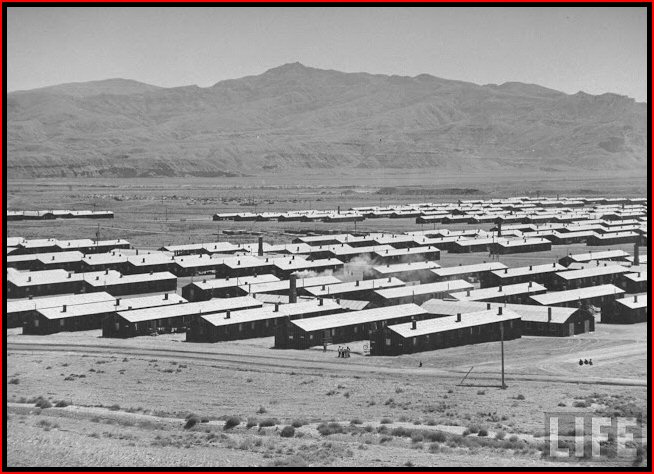
Seventy years ago, US soldiers bearing bayoneted rifles came marching up to the front door of our family's home in Los Angeles, ordering us out. Our crime was looking like the people who had bombed Pearl Harbor a few months before. I'll never forget that day, nor the tears streaming down my mother's face as we were forcibly removed, herded off like animals, to a nearby race track. There, for weeks, we would live in a filthy horse stable while our "permanent" relocation camp was being constructed thousands of miles away in Arkansas, in a place called Rohwer.

I recently revisited Rohwer. Gone were the sentry towers, armed guards, barbed wire and crudely constructed barracks that defined our lives for many years. The swamp had been drained, the trees chopped down. Only miles and miles of cotton fields. The only thing remaining was the cemetery with two tall monuments.

Because I was a child, I didn't understand the depth of the degradation and deprivation my parents suffered, or how courageous and foresighted my mother had been to smuggle a sewing machine into camp, which permitted her to make modest curtains for our bare quarters. I didn't grasp what a blow the ordeal was to my father's role as provider, as he struggled to keep our family together. The family ate, bathed and did chores along with a whole community, pressed together in the confines of a makeshift camp, in the oppressive heat and mosquito-infested swamps of Arkansas.

Later my family would be shipped to a high-security camp in Tule Lake, California, constructed in a desolate, dry lake bed in the north of the state. Three layers of barbed-wire fences now confined us. Out of principle, my parents had refused to answer yes to a "loyalty" questionnaire the government had promulgated. It had asked whether they would serve in the US army and go wherever ordered, and whether they would swear allegiance to the US government and "forswear" loyalty to the Japanese emperor – as if any had ever sworn such loyalty in the first instance.

Because the government had already taken so much from us, and broken its promise of "liberty and justice for all", how could my parents give them the satisfaction of a forced oath? I still remember the irony of holding my hand to my heart and pledging allegiance to the US flag in the tar-paper barrack schoolroom, even as armed guards watched over us and barbed wire kept us locked inside that prison, without charge, trial or due process.

My father once said: "America is a democracy as great as the people can be, but also as fallible." When I was a teenager, I began to understand better what had been done to us, and to question my own father about it. In one heated exchange, I said to him angrily: "Why didn't you do anything, Daddy? You led us like sheep to slaughter!" And for the first time, I saw the great sadness in his eyes as he said simply,: "Maybe you're right" – and turned and walked from the table, shutting his bedroom door behind him.

I will always regret those words. The tragedy of the internment of 120,000 Japanese Americans was not only that it was the greatest violation of our constitutional guarantees, but that it broke apart families and whole communities, and left scars that today remain unhealed, even after the government later apologised and issued reparations. It was almost a half-century too late. President Ronald Reagan only reluctantly signed the Civil Liberties Act of 1988. It expressed regret for the injustice and paid a token redress of $20,000 to those survivors still alive. My father had already passed away in 1979, never to know of the apology or receive the redress money. I donated the sum to the most fitting institution, the Japanese American National Museum, which tells the story of the experience of Americans of Japanese ancestry.

When I returned to Rohwer this year, it was not in anger or sadness, but with a deep resolve to help ensure such a thing never happens again within our shores. I will soon be appearing in Allegiance, the first piece of American musical theatre to ever address the subject of the internment, which remains one of the darkest and most little-known chapters of our history. We also plan to bring the show to the great stage of Broadway next year, so that the world can hear the story and our profound message: "Never forget, never again." Gruniad


Following Carlin's recommendation, some snippets from Google search, japanese americans 1942 wiki.

Where have we heard this before?

Those that were as little as 1/16 Japanese could be placed in internment camps. There is evidence supporting the argument that the measures were racially motivated, rather than a military necessity. For example, orphaned infants with "one drop of Japanese blood" (as explained in a letter by one official) were included in the program.


Ah! the old self interest. Not much changes does it? 150 Jews were massacred in York’s Clifford Tower 1190AD

(A farmer speaking) "We're charged with wanting to get rid of the Japs for selfish reasons. We do. It's a question of whether the white man lives on the Pacific Coast or the brown men. They came into this valley to work, and they stayed to take over... If all the Japs were removed tomorrow, we'd never miss them in two weeks, because the white farmers can take over and produce everything the Jap grows. And we do not want them back when the war ends, either."

Surveillance and data gathering. But we don't have to worry about such things being misused do we? Not in these enlightened times I'm sure.

As early as 1939, when war broke out in Europe and while armed conflict began to rage in East Asia, the FBI and branches of the Department of Justice and the armed forces began to collect information and surveillance on influential members of the Japanese community in the United States.....

.......After the Pearl Harbor attacks, Roosevelt authorized his attorney general to put into motion a plan for the arrest of individuals on the potential enemy alien lists. Armed with a blanket arrest warrant, the FBI seized these men on the eve of December 8, 1941.


One good man.

During World War II, Colorado governor Ralph Lawrence Carr was the only elected official to publicly apologize for the internment of American citizens. The act cost him reelection, but gained him the gratitude of the Japanese American community, such that a statue of him was erected in Sakura Square in Denver's Japantown. japanese americans 1942 wiki.


World War Two - Japanese Internment Camps in the USA

Alleged US Army doc: re-education camps and psy-op missions aimed at activists 03 May, 2012

Saturday, April 07, 2012

Be Very Afraid in The Land of The Free


“See Something Say Something” Campaign Could Allow People to Label ANY AMERICAN a Suspected “Terrorist” … Just Like in Nazi Germany or Stasi East Germany
WashingtonsBlog
February 12, 2012

List of Actions or Beliefs Which May Get You Labeled a Terrorist Grows Daily

Every American could – literally – be labeled a suspected terrorist under current governmental criteria.

Specifically, the following actions may get a U.S. citizen labeled as a suspected terrorist today:

Holding the following beliefs may also be considered grounds for suspected terrorism: Lots more.


Monday, March 19, 2012

Women's Reproductive Rights: America Out of Control

I remind you, the year is 2012, America is a western industrial country.

And this is just one of hundreds, if not thousands of stories that abound right now on States preoccupation with, and invasion of, Women's reproductive organs and rights. Lawmakers in the US! they could put the Taliban to shame.


How the "Pro-Life" Movement Puts Women Behind Bars

In Alabama, the claim that eggs, embryos and fetuses have separate legal rights has led to the jailing of 60 women.
By Lynn Paltrow and Emma S. Ketteringham
March 17, 2012

Numerous organizations and leaders who identify themselves as pro-life have assured the public that their efforts to re-criminalize abortion and establish the unborn as separate legal persons will not result in the prosecution and imprisonment of women. Yet, in Alabama alone, the claim that eggs, embryos and fetuses have separate legal rights has provided the basis for arresting approximately 60 women.

These women are being prosecuted under Alabama’s 2006 law designed to provide special penalties for people who bring children into methamphetamine laboratories. Its official title is "Endangerment of Exposing a Child to an Environment in Which Controlled Substances are Produced or Distributed" and it provides that a person “commits the crime of chemical endangerment” by “exposing a child to an environment in which he or she...knowingly, recklessly, or intentionally causes or permits a child to be exposed to, to ingest or inhale, or to have contact with a controlled substance.”

This law makes no mention of pregnancy, pregnant woman, drug use, fetus, or any other words that would make it applicable to a pregnant woman who uses a controlled substance and seeks to continue her pregnancy to term. In fact, the Alabama legislature has repeatedly refused to amend this law or to create others that would address the issue of pregnancy and drug use through the criminal law.

Nevertheless prosecutors have argued, and the Alabama’s Court of Criminal Appeals has agreed, that the word “child” in the statute includes a “viable fetus” and therefore may be used to arrest and jail women who become pregnant, eschew abortion, go to term, and try to bring life into this world, despite having used a controlled substance.

The Appeals Court decision reaches far beyond women who use illegal drugs or even drug use at all. Many prescription drugs are controlled substances and there is no defense under the law if the drug is prescribed to the pregnant woman. This means that a pregnant woman who is prescribed a controlled substance (and her doctor who prescribed it) are now potentially subject to criminal penalties as well. And, if the word “child” in one Alabama criminal laws means “viable fetus,” then surely it would have to mean the same thing in others – including the state’s child abuse and related laws. This means that women are potentially criminally liable for an unlimited range of actions, inactions or circumstances during pregnancy believed by police and prosecutors to pose a risk of harm to the fetus. (Think “personhood” measure in disguise.)

Hope Ankrom and Amanda Kimbrough are two of the 60 women who have been charged under the chemical endangering law – not for running meth labs or bringing children to them, but rather for continuing their pregnancies to term in spite of having a drug problem. Ankrom and Kimbrough have appealed their convictions to the Alabama Supreme Court.

Forty-seven medical, public health and legal advocacy groups and individuals, including the American Medical Association, the American Psychiatric Association, the American College of Obstetricians and Gynecologists, and the American Nurses Association filed an amicus (friend of the court) brief in support of these mothers. They urge the court to reverse the lower court’s radical extension of the chemical endangering law to permit prosecution and punishment of new mothers, pregnant women, and their doctors.

These organizations and experts explain that while they do not in any way endorse the use of illegal drugs during pregnancy, medical consensus is that illegal drug use by pregnant women does not pose risks qualitatively different or greater than a wide range of other actions, inactions, exposures, and circumstances engaged in or experienced by pregnant women, such as smoking cigarettes. Go to page two.


How Legal, Medical Marijuana Got One Couple's Children Violently Snatched Away Link

Sunday, March 11, 2012

H.R. 347 Another Nail in Democracy's Coffin

Anybody fancy a guess at the year when America stops all pretence that it's a democracy? Of course, it will require a false flag on a fairly grand scale in order for the establishment to declare (temporary) martial law. I wonder what form that will take?


Obama Signs Anti-protest Trespass Bill
March 10, 2012

Only days after clearing Congress, US President Barack Obama signed his name to H.R. 347 on Thursday, officially making it a federal offense to cause a disturbance at certain political events — essentially criminalizing protest in the States.


RT broke the news last month that H.R. 347, the Federal Restricted Buildings and Grounds Improvement Act of 2011, had overwhelmingly passed the US House of Representatives after only three lawmakers voted against it. On Thursday this week, President Obama inked his name to the legislation and authorized the government to start enforcing a law that has many Americans concerned over how the bill could bury the rights to assemble and protest as guaranteed in the US Constitution.

Under H.R. 347, which has more commonly been labeled the Trespass Bill by Congress, knowingly entering a restricted area that is under the jurisdiction of Secret Service protection can garner an arrest. The law is actually only a slight change to earlier legislation that made it an offense to knowingly and willfully commit such a crime. Under the Trespass Bill’s latest language chance, however, someone could end up in law enforcement custody for entering an area that they don’t realize is Secret Service protected and “engages in disorderly or disruptive conduct” or “impede[s] or disrupt[s] the orderly conduct of Government business or official functions.”

The Secret Service serves as the police that protects not just current and former American presidents, but are also dispatched to monitor special events of national significance, a category with a broad cast of qualifiers. In the past, sporting events, state funerals, inaugural addresses and NATO and G-8 Summits have been designated as such by the US Department of Homeland Security, the division that decides when and where the Secret Service are needed outside of their normal coverage.

Mara Verheyden-Hilliard of the Partnership for Civil Justice Fund tells the International Business Times that the Trespass Bill in its current form “means it's easier to prosecute under 'knowingly,'” instead of both knowingly and willfully, “which is an issue because someone could knowingly enter a restricted but not necessarily realize they are committing a crime.” Speaking with IB Times, Verheyden-Hilliard tries to lay to rest claims that the Constitution will be crippled by the Trespass Bill, but acknowledges that it does indeed allow law enforcement to have added incentive to arrest protesters who could be causing a disturbance.

"[HR 347] has been described as a death knell for the First Amendment, but that isn't supported by the facts," Verheyden-Hilliard adds. "This has always been a bad law."

Gabe Rottman of the American Civil Liberties Union adds to IB Times, "Bottom line, it doesn't create any new violations of the law.” So far, however, it has raised awareness of the levels that the US government are willing to go to in order to make it harder to express ones’ self.

Under the act, protesting in areas covered by Secret Service could land a demonstrator behind bars, and the thing about the Secret Service (in case you couldn’t tell by their name), is that they don’t always make it clear where they are. You could even say that the service they provide, at times, is kept secret.

Presidential hopefuls Newt Gingrich, Mitt Romney and Rick Santorum are now officially covered under Secret Service protection, making it a federal offense to disrupt a campaign stop. That means whether it’s by way of a glitter bomb protest or causing a disturbance on the same Holiday Inn hotel floor that Santorum is staying in, doing such could cause a bit of a legal battle for the persons involved.

Although the G-8 Summit originally scheduled for Chicago this spring would have made much of the Windy City a protected area where crimes could easily be tacked on to arrested protesters, the event was moved this week to the presidential retreat at Camp David. In turn, many have suggested that the White House is only going out of their way to limit protesting rights. While a Chicago summit would have meant the Trespass Bill could have been enforced in the same area where thousands of demonstrators were expected to protest, moving the event to a heavily fortified rural location will instead deter protesters from likely coming close to the meeting at all.

And before you forget, the president can now detain you for getting too close to his front yard, order your assassination if the country considers you a threat and lock you away for life with no charge if you’re alleged to be a terrorist. You, on the other hand, can’t yell obscenities at Newt Gingrich without risking arrest. RT

Related: ''Humans are essentially subjective beings'' Strafor: Blood on Their Hands